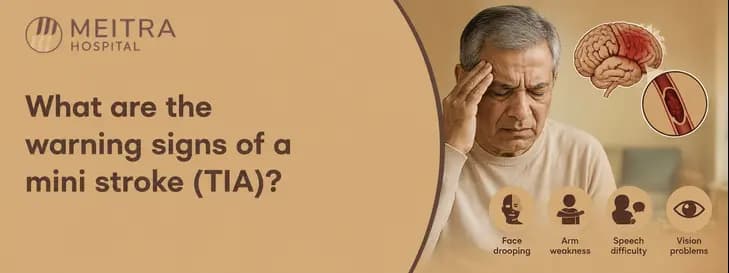

A mini stroke, also called a transient ischemic attack (TIA), mimics a full stroke but resolves within minutes to hours. Unlike a major stroke, a TIA causes no permanent brain damage, yet it is a serious warning sign that your brain is not getting enough blood flow. Every year, thousands of people in India experience a TIA and miss the opportunity to prevent a life-changing stroke.
This article walks through the warning signs of a mini stroke (TIA) in the same detail a neurologist would use at the bedside: what the symptoms actually look like, which ones get missed, why the first 48 hours after a TIA matter more than any other window in stroke prevention, and what an evaluation should involve.
What Is a Mini Stroke (TIA), Really?
A transient ischemic attack (TIA), commonly called a "mini stroke" happens when blood flow to part of the brain is briefly interrupted, usually by a small clot. Unlike a full stroke, the blockage clears on its own before it causes permanent tissue death, which is why symptoms disappear.
How a TIA differs from a full stroke: The symptoms are identical, the same face drooping, arm weakness, and speech trouble. The only real difference at the moment it's happening is time: in a TIA, blood flow is restored before brain cells die; in a stroke, it isn't. Doctors cannot tell the two apart from symptoms alone, which is exactly why every suspected TIA needs the same urgency as a stroke.
How long do TIA symptoms last? Most TIA episodes resolve within 5 to 20 minutes. Some last up to an hour, and by strict definition, a TIA can be diagnosed up to 24 hours after onset if imaging shows no permanent tissue damage. If symptoms last longer than a few hours, or if a brain scan finds an injury, doctors may reclassify the event as a minor stroke rather than a TIA, the treatment urgency is the same either way.
The 7 Warning Signs of a Mini Stroke You Shouldn't Ignore
Neurologists commonly teach the public the BE FAST checklist, an expanded version of the classic FAST test, because it catches signs that FAST alone misses, particularly balance and vision problems.
| Letter | Sign | What it looks like |
|---|---|---|
| B – Balance | Sudden loss of balance or coordination | Stumbling, dizziness, or a spinning sensation (vertigo) with no clear cause |
| E – Eyes | Sudden vision changes | Blurred, doubled, or blacked-out vision in one or both eyes |
| F – Face | Facial drooping | One side of the face sags or feels numb; smile looks uneven |
| A – Arm | Arm weakness | One arm drifts downward or feels weak when both are raised |
| S – Speech | Speech difficulty | Slurred words, trouble finding words, or not making sense |
| T – Time | Time to act | Note when symptoms started and seek emergency care immediately |
Sign-by-sign detail:
-
Sudden imbalance or vertigo; often dismissed as low blood sugar or fatigue, especially in older adults.
-
Vision disturbance; can affect one eye or both, and may present as a "shade coming down" rather than total blackout.
-
Facial drooping; frequently noticed by a family member or coworker before the person feels it themselves.
-
One-sided arm or leg weakness/numbness; the hallmark sign; ask the person to raise both arms and hold them level.
-
Slurred or garbled speech; or difficulty understanding what others are saying (receptive, not just expressive, trouble).
-
Sudden, severe headache with no known cause; less common in TIA than in hemorrhagic stroke, but worth flagging.
-
Sudden confusion or trouble processing information; easy to mistake for tiredness, especially if it's brief.
Lesser-Known TIA Symptoms People Miss
Textbook signs get taught often; the ones below are the reason people delay care.
-
Amaurosis fugax is a sudden, painless loss of vision in one eye, often described as a dark curtain dropping over the visual field. It's caused by a temporary blockage in the artery supplying the retina and is considered a TIA of the eye. It is one of the most distinct TIA signs, feeling like a dark curtain being pulled down over one eye, and because it clears within minutes, people frequently assume it was eye strain.
-
Atypical symptoms in women deserve special mention. Alongside classic BE FAST signs, women having a TIA or stroke may experience sudden nausea, hiccups, chest pain, or general weakness rather than clear-cut one-sided numbness, symptoms that get attributed to anxiety, indigestion, or menopause, delaying diagnosis.
-
Sudden confusion without physical weakness is another commonly missed sign, particularly in older adults, where it's mistaken for a "senior moment," low blood sugar, or dehydration rather than a neurological event.
What Causes a TIA? Risk Factors to Know
A TIA is usually caused by a small blood clot or fatty plaque (from atherosclerosis) that temporarily blocks a blood vessel supplying the brain. Common contributing factors include:
-
High blood pressure (the single largest modifiable risk factor)
-
Atrial fibrillation and other irregular heart rhythms
-
Diabetes and insulin resistance
-
High LDL cholesterol and carotid artery narrowing
-
Smoking and heavy alcohol use
-
Obesity and physical inactivity
-
Family history of stroke or TIA
-
Age over 55, though TIAs can occur in younger adults with underlying heart or clotting conditions
Also Read: Emergency Cardiac Care in Kozhikode: 24/7 Heart Disease Support


What to Do If You Notice These Signs (Immediate Steps)
-
Note the exact time symptoms started. This single detail shapes every treatment decision that follows.
-
Call for emergency medical transport rather than self-driving. Paramedics can begin assessment en route and alert the receiving hospital.
-
Do not wait for symptoms to "pass" before seeking help. Even if they resolve in minutes, go to an emergency department the same day.
-
Avoid food, water, or medication until a clinician has evaluated swallowing safety and ruled out complications.
-
Bring a list of current medications and medical history, especially blood thinners, which affect emergency treatment choices.
How Doctors Diagnose and Treat a TIA
A same-day TIA workup typically includes:
-
Brain imaging (CT or MRI, often with angiography) to rule out a completed stroke and locate the source of the clot
-
Carotid ultrasound or CT angiography to check for narrowed neck arteries
-
Cardiac evaluation (ECG, sometimes extended heart-rhythm monitoring) to detect atrial fibrillation
-
Blood tests for cholesterol, blood sugar, and clotting function
-
Risk scoring (such as the ABCD² score) to estimate short-term stroke risk and decide whether admission is warranted
Treatment is aimed at the underlying cause rather than the TIA itself, since the event has already resolved. This can include antiplatelet or anticoagulant medication, statins, blood pressure management, and, in select cases where a carotid artery is significantly narrowed, a minimally invasive procedure to clear or stent the vessel before it causes a full stroke.
Also Read: Preventive Health Measures for Hypertension Control
Can a Mini Stroke Be Prevented?
Most TIAs are linked to modifiable risk factors, which means prevention is genuinely achievable for most people:
-
Keep blood pressure under control (home monitoring helps catch spikes early)
-
Manage cholesterol and blood sugar through diet, medication, or both
-
Stop smoking, one of the fastest ways to lower clot risk
-
Stay physically active most days of the week
-
Limit alcohol intake
-
Treat sleep apnea and irregular heartbeats if diagnosed
-
Get regular checkups if you have a family history of stroke or heart disease
Why Meitra Hospital for TIA and Stroke Care in Kerala
With TIA and stroke, speed, accurate imaging, and coordinated specialist care can make a critical difference. Meitra Hospital in Kozhikode provides this through its Advanced Stroke Care Centre (MASC) under the Centre of Excellence for Neurosciences, with stroke specialists and neurologists available around the clock.
Key strengths include:
-
Rapid stroke assessment: Meitra is the only centre in North Kerala equipped with Rapid AI, an advanced imaging technology designed to extend the treatment window for eligible stroke patients.
-
Multidisciplinary expertise: Interventional Neurology, Neurosurgery, Emergency Medicine, Critical Care, Radiology, Rehabilitation, and Neuropsychiatry teams work together for coordinated care.
-
Advanced hospital infrastructure: Meitra is JCI-accredited, along with NABH and NABL certifications, supporting standardized emergency and neurological care.
-
Regional and international access: International patient services, including Arabic-speaking coordinators, help patients from the Gulf and other regions access specialized neurological care in Kerala.
For families across Malabar, this means access to advanced stroke treatment in Kerala, neurological evaluation, rehabilitation, and emergency care without necessarily travelling to a major metro city.
If you experience sudden weakness, speech difficulty, facial drooping, or vision changes, seek emergency medical attention immediately, even if the symptoms disappear.
Conclusion
A mini stroke rarely announces itself as an emergency, it fades before you've even decided whether to worry about it. But the data is unambiguous: a TIA is one of the strongest predictors of a full stroke that medicine has, with much of that risk concentrated in the first two days.
Learning the BE FAST signs, recognising the symptoms that are easy to dismiss (like sudden vision loss in one eye or brief confusion), and treating every episode as urgent, not "it passed, so it's fine" is what actually prevents the bigger event. If you or someone you love experiences even a brief version of these symptoms, get evaluated the same day, at a centre equipped to move fast.
Don't wait for symptoms to return. Chat with our care assistant for immediate guidance, or contact Meitra Hospital's Advanced Stroke Care Centre to speak with our neurology team for an urgent evaluation.
Medical Disclaimer: This article is for general informational purposes only and is not a substitute for professional medical advice, diagnosis, or treatment. Always seek the advice of a qualified physician or emergency medical service with any questions regarding a medical condition, and call emergency services immediately if you or someone else is experiencing symptoms of a stroke or TIA.