
Cardiovascular disease is the single largest cause of death in India, accounting for roughly 28% of all deaths nationally, and South Indian states carry among the country's highest age-standardised burdens of coronary artery disease.
The clinical implication is direct: more patients need timely, precise revascularisation and the doctors performing those procedures spend tens of thousands of hours next to a fluoroscope, in lead aprons, with measurable risks to their own health.
Two technologies have emerged to address both sides of that equation. The hybrid cath lab brings open surgical capability into the catheterization suite, so a complex case never has to be moved mid-procedure. The robotic PCI platform lets an interventional cardiologist drive guidewires, balloons and stents with sub-millimetric accuracy from a lead-shielded cockpit.
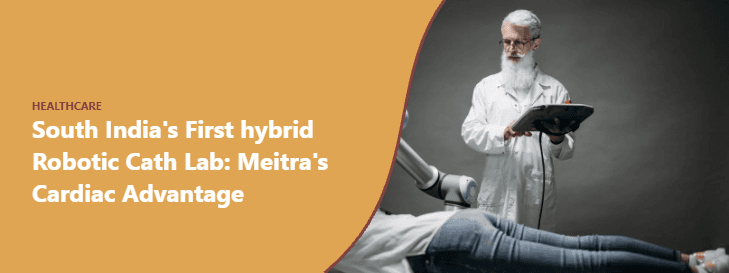
Meitra Hospital in Kozhikode (Calicut), Kerala has commissioned South India's first cath lab that combines both, in a single integrated room. This article explains how it works, who it helps, what the published evidence actually shows, and where the limits of the technology still are.
What Is a Hybrid Cath Lab?
A hybrid cath lab is a procedural suite engineered to function simultaneously as a diagnostic catheterization laboratory and a fully sterile cardiac operating theatre. Instead of moving a patient between rooms if a percutaneous case escalates, the heart team can convert workflows in place.
The defining components are:
- A fixed, high-resolution C-arm or bi-plane fluoroscopy system with 3D rotational angiography and CT-fusion capability.
- OR-grade laminar airflow with HEPA filtration and positive-pressure ventilation.
- A full anaesthesia workstation, perfusion access, and cardiopulmonary bypass readiness.
- Integrated intracoronary imaging and physiology IVUS, OCT, and FFR co-registered with the angiogram.
- Lead-lined walls, vibration isolation, and ceiling clearance typically of 9'6" to 9'9" to accommodate the imaging gantry.
Procedures that are well-suited to hybrid suites include TAVI/TAVR, MitraClip, EVAR and TEVAR, hybrid coronary revascularisation, complex chronic total occlusion (CTO) PCI, paediatric structural interventions, and aneurysm repair.
The common thread is that all of these benefit from the option to switch between catheter-based and surgical strategies without breaking sterility or transferring the patient.
What Is a Robotic Cath Lab (Robotic PCI)?
Robotic percutaneous coronary intervention, R-PCI is the use of a vascular robotic platform to perform angioplasty and stenting. The interventional cardiologist sits in a radiation-shielded interventional cockpit and uses joystick and touchscreen controls to drive an articulated robotic arm mounted to the cath lab table. A disposable sterile cassette holds and advances the guide catheter, guidewire, balloon and stent.
The technology has matured over two decades. The first robotic PCI was performed with a prototype in 2004, and the first commercial system received FDA approval in 2012.
Second-generation platforms added robotically-controlled guide-catheter movement and automated wire manoeuvres such as "wiggle, spin, and rotate-on-retract" features that replicate the small, repetitive motions experienced operators use to cross difficult lesions. Most of the published clinical data on R-PCI safety and efficacy was generated using these first- and second-generation systems over roughly a decade of practice.
Hybrid + Robotic: Why the Combination Matters
A standalone hybrid lab provides surgical bail-out and structural-heart capability. A standalone robotic platform provides precision and operator radiation safety. Combining the two in one room compounds both advantages and unlocks workflows that neither configuration can deliver alone:
- Single-anaesthesia hybrid coronary revascularisation: robotic PCI of non-LAD vessels combined with minimally invasive direct coronary artery bypass (MIDCAB) on the LAD, performed in the same sitting.
- Seamless escalation: a complex robotic PCI that cannot be completed percutaneously can be converted to surgical revascularisation without patient transfer.
- Structural heart cases with surgical fallback: TAVI, valve-in-valve and MitraClip procedures performed with robotic-assisted access in a fully surgical environment.
- Complex peripheral and aortic interventions with the precision of robotic catheter navigation and the safety net of open vascular surgery. This is why hybrid cath labs are increasingly described, in clinical literature and operator commentary, as the operating environment cardiac and vascular medicine is moving toward.
How a Robotic PCI Procedure Actually Works?
For patients and referring physicians who have only seen a conventional cath lab, the workflow inside a hybrid robotic suite is worth walking through step by step.
- Vascular access, usually radial, sometimes femoral, is established manually, and a guide catheter is placed in the coronary ostium. This part is unchanged from conventional PCI.
- The guidewire, balloon and stent are loaded into the sterile cassette mounted on the robotic arm at the side of the table.
- The interventional cardiologist scrubs out and moves to the lead-shielded cockpit, where a remote console displays the live fluoroscopic image, hemodynamics, and intracoronary imaging on a unified screen.
- Using joystick and touchscreen controls, the operator advances the wire across the lesion, sizes the vessel using IVUS or OCT, selects stent length to the millimetre, deploys the stent, and post-dilates as needed.
- If the case requires over-the-wire devices, rotational atherectomy, or certain CTO techniques, the operator returns to the table to complete those steps manually, then re-engages the robot. This is a real workflow constraint of current-generation platforms and is openly acknowledged by experienced operators.
At Meitra, the lab is run as a multi-disciplinary heart team, interventional cardiology, cardiothoracic surgery, anaesthesia, perfusion, structural-imaging cardiology, cath-lab nursing and radiographers, trained jointly on the platform rather than as individual operators learning a new tool.
Patient Benefits: What Robotic + Hybrid Means for the Person on the Table
For patients, the practical advantages cluster around precision and consolidation of care:
- More accurate stent length selection. Robotic measurement to the millimetre reduces "geographic miss" and the need for additional overlapping stents.
- Lower contrast volume and fluoroscopy time in suitably selected cases.
- Single-session hybrid procedures. Patients eligible for hybrid coronary revascularisation can avoid two separate admissions and two separate anaesthetics.
- Smaller scatter field in some workflows, which can translate into reduced patient radiation as well.
- Faster recovery versus open surgery for cases that can be completed percutaneously inside a hybrid suite, while still having full surgical capability immediately available if needed.
Why Meitra’s Heart and Vascular Care COE?
The Meitra model is built on Governance and Multidisciplinary Expertise. In 2026, the "Heart Team" is the mandatory decision-making body for all cardiovascular interventions at our hospital.
The Meitra Heart Team Composition
- Lead Interventional Cardiologist: Robotic-certified with a minimum of 500+ robotic-assisted cases.
- Senior Cardiothoracic Surgeon: On-site in the Hybrid suite for all high-risk structural cases.
- Cardiac Imaging Specialist: Dedicated to real-time Intravascular Ultrasound (IVUS) and Optical Coherence Tomography (OCT) interpretation.
- Specialized Nursing & Perfusion: A team trained specifically in Robotic Cassette Management and sterile "Hybrid" protocols.
One of the primary concerns for patients is the "Robotic Premium." However, in 2026, the Total Cost of Care at Meitra is often lower than manual procedures when factoring in long-term health.


The Patient Journey: A 2026 Experience at Meitra
We have redesigned the cardiac patient pathway to be "Digital-First" and "Patient-Centric."
Stage 1: The Digital Twin Analysis
Before you enter the lab, your CT data is used to create a Digital Twin of your heart. Our surgeons perform a "Virtual Procedure" on the software to identify the best angle for the robotic arm.
Stage 2: The Robotic Procedure
You will be in the Hybrid Lab, usually under conscious sedation (awake but relaxed). Your cardiologist will be at the Interventional Cockpit, three meters away from the X-ray source. You will hear the doctor communicating with the robotic arm as it moves with mechanical precision through your arteries.
Stage 3: Fast-Track Recovery
Most robotic PCI patients at Meitra are ambulatory (walking) within 4 hours. By using "Radial Access" (the wrist) and advanced hemostatic patches, we eliminate the need for the painful 12-hour bed rest required in older protocols. Discharge is typically within 24 hours.
Safety, Quality, and Regulatory Compliance at Meitra
Meitra Hospital operates under the most stringent 2026 clinical governance frameworks:
- NABH & JCI Accreditation: Our Hybrid Lab meets the highest international standards for patient safety and clinical outcomes.
- NMC Certification: All robotic cardiologists are registered with the National Medical Commission and hold specific "Advanced Robotics" credentials.
- CDSCO/DCGI Approved: All stents, valves, and robotic disposables are approved for use in India, ensuring the highest material safety.
- Radiation Monitoring: Every procedure is logged in our 2026 Dose-Track System, ensuring that the cumulative radiation for the patient remains well below safety thresholds.
Meitra's Hybrid Robotic Cath Lab: What It Adds to South India?
Meitra Hospital, Kozhikode, has positioned itself as the first cardiac centre in South India to integrate a robotic PCI platform inside a hybrid OR-grade theatre. The clinical relevance for the region is straightforward:
- Catchment burden. Kerala and the broader South Indian region carry one of the country's highest age-standardised CAD burdens. Local access to integrated hybrid + robotic capability shortens referral chains for patients who would otherwise travel out of state for complex structural or coronary procedures.
- Heart-team model. Interventional cardiology, cardiothoracic surgery, structural-imaging cardiology and anaesthesia operate as a single unit in the same room, rather than across separate departments.
- Procedural breadth. The suite supports the full hybrid catalogue TAVI, MitraClip, hybrid coronary revascularisation, EVAR/TEVAR, complex PCI and paediatric structural interventions with robotic precision available where appropriate.
- Audit and outcomes. Meitra is participating in prospective procedural and outcome data capture, mirroring the global call from leading centres to build registry-grade evidence on robotic and hybrid interventions.
The point is not that the technology replaces clinical judgement, it does not, but that South Indian patients now have local access to a level of integrated cardiac care that previously required substantial travel.
Talk to Meitra's Heart Team
If you or a family member has been advised angioplasty, valve replacement, or surgery for complex coronary, structural, or vascular disease, a second opinion from an integrated heart team is rarely a wasted step and increasingly, it is what changes the treatment plan.
At Meitra Hospital, Kozhikode, that conversation happens with the same team that runs South India's first hybrid robotic cath lab interventional cardiologists, cardiothoracic surgeons, structural-imaging specialists and cardiac anaesthetists, reviewing your case together rather than in isolation. You will get a clear answer on three things:
- Whether your case is suitable for a robotic, hybrid, or conventional approach and why.
- A transparent, written cost estimate based on your specific anatomy and clinical profile.
- A realistic recovery and follow-up plan you can plan your life around.
Meitra's heart team will review your angiogram and tell you honestly robotic, hybrid, or conventional whichever gives you the best outcome. Request a second opinion.