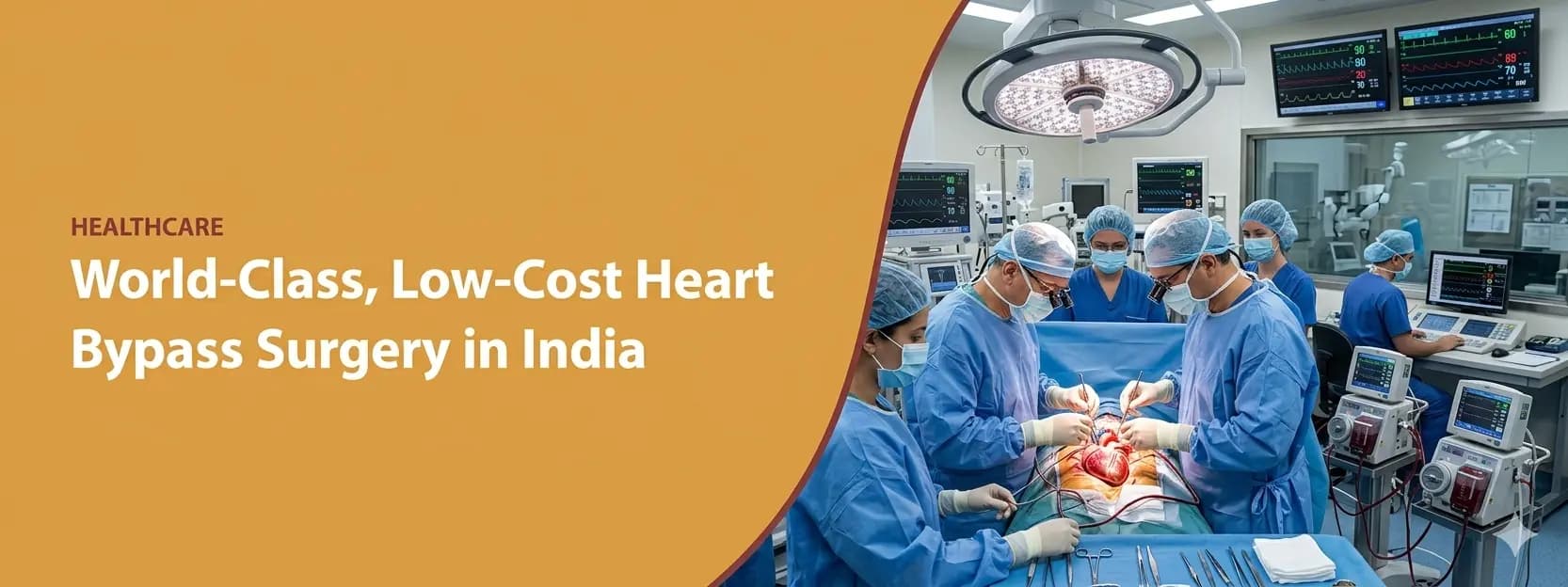

Every year, thousands of people outside India, and many within the country itself face the same painful moment: a cardiologist recommends coronary artery bypass grafting (CABG), and the next question is whether they can afford it. In the United States, a heart bypass surgery can cost anywhere from $70,000 to $150,000 . In India, the same procedure, performed by internationally trained surgeons at accredited hospitals, typically ranges from $4,000 to $6,500 (approximately ₹3.3 lakh to ₹5.4 lakh), a difference of up to 90% for comparable clinical outcomes.
That price gap is not theoretical. According to a 2024 report cited in Medical Buyer, a heart bypass in the US averages $144,000 (INR 1.2 crore), in Singapore $18,500 (INR 15.4L), and in India approximately $5,200 (INR 4.3L) making India the most affordable destination among all major medical tourism hubs globally. But cost alone is never the whole story. Understanding what the procedure involves, what actually drives the price differences, and how to evaluate hospitals is what separates a good decision from a risky one.
What Is Heart Bypass Surgery (CABG)?
Coronary artery bypass grafting is a surgical procedure performed when one or more of the coronary arteries the vessels that supply blood and oxygen to the heart muscle become severely narrowed or blocked, usually due to the build-up of fatty plaque (atherosclerosis).
During the surgery, a healthy blood vessel is harvested from another part of the body typically the chest wall (internal mammary artery), leg (saphenous vein), or forearm (radial artery) and is grafted to create a detour around the blockage. Blood can then flow freely to the heart muscle again.
CABG is typically recommended when:
- You have multiple blocked coronary arteries not suitable for stenting
- Chest pain (angina) doesn't respond to medication or lifestyle changes
- You've had a heart attack and certain arteries remain critically narrowed
- You have left main coronary artery disease, which carries significant risk if untreated
- A previous angioplasty or stent has failed (restenosis)
Types of Bypass Surgery Available in India
Understanding the type of procedure you're being recommended helps you ask better questions and understand the cost variation.
1. On-Pump CABG (Conventional Bypass) The most common form. The heart is temporarily stopped using a heart-lung machine (cardiopulmonary bypass) that takes over circulation during surgery. This gives the surgeon a still, bloodless field for precise grafting.
2. Off-Pump CABG (Beating Heart Surgery) Performed on a beating heart without the heart-lung machine. Requires specialised skills and equipment. Associated with a lower risk of stroke, kidney injury, and cognitive side effects particularly in older patients or those with diabetes. Not suitable for every anatomy.
3. Minimally Invasive CABG (MICS-CABG) Performed through small incisions on the side of the chest rather than a full sternotomy (splitting the breastbone). Faster recovery, less pain, lower infection risk. Requires advanced surgical expertise and is appropriate in selected cases.
4. Hybrid CABG Combines bypass surgery with angioplasty/stenting. The most severely blocked artery gets a bypass graft; less critical ones are treated with stents in the same setting. Useful for complex multi-vessel disease.
What Does Heart Bypass Surgery Actually Cost in India?
Costs vary depending on hospital type, city, number of grafts, and technique used. Here's a realistic breakdown:
| Type of Procedure | Approximate Cost (INR) | Approximate Cost (USD) |
|---|---|---|
| Single vessel bypass (CABG) | INR 2L - 3L | $2,400 – $3,600 |
| Double vessel bypass | INR 2.5L- 4L | $3,000 – $4,800 |
| Triple vessel bypass | INR 3L-5L | $3,600 – $6,000 |
| Off-pump CABG (beating heart) | INR 3L - 5.5L | $3,600 – $6,6003L |
| Minimally invasive CABG | INR 4.5L - 6L | $5,400 – $7,200 |
Note: These are approximate ranges for reputed private hospitals. Costs at government hospitals can be significantly lower, though facilities may vary. Costs can rise if ICU stay is extended, additional procedures are required, or complications occur.
What's Typically Included in the Package?
- When hospitals offer a packaged price, it usually covers:
- Pre-operative tests (ECG, echocardiogram, coronary angiogram, blood work, chest X-ray)
- Surgeon, anaesthetist, and OT team fees
- ICU stay (typically 2–3 days)
- Ward/room charges (typically 3–5 additional days)
- Standard post-operative medications
What may not be included:
- Implants, specialised graft materials, or stents used alongside
- Extended ICU stay if complications arise
- Physiotherapy sessions
- International travel, visa, and accommodation for medical tourists
Always request an itemised estimate not just a package total.


Why Meitra Hospital, Kozhikode Stands Out for Low-Cost Heart Bypass Surgery
If you're applying the checklist from the previous section to hospitals in India, Meitra Hospital in Kozhikode, Kerala checks the boxes that genuinely matter not the cosmetic ones.
1. A Cardiac Programme Led by Named, Verifiable Surgeons
The cardiac surgical department at Meitra is led by Dr. Murali P. Vettath, a cardiovascular surgeon with over 7,000 open-heart surgeries to his credit more than 4,500 of them performed on a beating heart (off-pump CABG), with a documented mortality rate of just 0.5%. That figure is not a marketing claim; it's a number he has published and presented internationally.
Dr. Vettath was the first surgeon to perform minimally invasive cardiac surgery (MICS) in Kerala in July 2002, and he performed Meitra's first heart transplantation in North Kerala in 2015. He has also invented and patented the SIMS (Simple Indian Made Stabiliser) a surgical device for beating heart bypass used in over 1,500 procedures and the Vettath's Anastomotic Obturator (VAO), patented in 2008.
2. Technology That Changes Outcomes, Not Just Impressions
Meitra Hospital houses the first Advanced Robotic Hybrid Cardiac Catheterisation Lab with Dyna CT capability in South India. This matters for two specific reasons:
- Hybrid procedures: Patients with multi-vessel disease can have bypass surgery and stenting performed in the same session, in one room, under one anaesthetic. This reduces overall procedural risk compared to staged procedures.
- Precision planning: Dyna CT imaging gives the surgical team three-dimensional coronary anatomy data that flat angiography cannot provide improving graft targeting and reducing the chance of missed lesions.
The cardiology department also uses Optical Coherence Tomography (OCT) for coronary stenting precision, and an Electrophysiology (EP) lab with cardiac mapping for patients who have bypass surgery complicated by arrhythmias.
3. Full Spectrum Cardiac Care Under One Roof
Most patients who arrive for bypass surgery have co-existing conditions valve disease, arrhythmia, heart failure, peripheral vascular disease. Meitra's cardiac programme doesn't treat CABG in isolation. The Centre for Excellence in Heart and Vascular Care includes:
- Clinical and Preventive Cardiology: Risk stratification and non-surgical management
- Interventional Cardiology: Angioplasty, stenting, TAVR (transcatheter valve replacement)
- Cardiovascular and Thoracic Surgery: CABG (on-pump, off-pump, MICS), valve surgery, heart transplantation
- Heart Failure Clinic: specialised management for patients with reduced ejection fraction
- Vascular Clinic: for patients with peripheral artery disease alongside coronary disease
- Advanced Foot Care Centre: for diabetic patients whose cardiac and vascular disease overlaps with limb complications.
This matters because bypass surgery on a patient with untreated valve disease, poorly controlled heart failure, or peripheral arterial compromise carries higher risk. Having all these subspecialties collaborating under one roof rather than referring between separate hospitals is a structural advantage in complex cases.
4. Location Advantage for Gulf, Malabar Coast, and International Patients
Kozhikode (Calicut) is directly connected to major Gulf hubs, Dubai, Doha, Muscat, Kuwait, Bahrain, by frequent direct flights. For the large population of Indian expatriates in the Middle East who return to India for major surgical treatment, Kozhikode is logistically closer and more familiar than Chennai, Hyderabad, or Delhi.
For patients within India, particularly from North Kerala, the Malabar coast, and parts of Karnataka, Meitra offers big-hospital cardiac capability without the travel burden of going to a metro city, and without the anonymity that comes with it. Post-operative follow-up consultations are a realistic possibility rather than a logistics problem.
What a Consultation at Meitra Actually Looks Like
Meitra's cardiac team accepts pre-consultation workup remotely. If you or a family member has already had a coronary angiogram, you can share the report, the angiogram images (digital), a recent echocardiogram, and your blood panels with the cardiac team. They will review your anatomy and advise whether CABG, angioplasty, hybrid approach, or medical management is the right path for your specific case before you book a flight or commit to any procedure.
This isn't unusual in good cardiac centres, but it's worth knowing that you don't have to travel first and decide later. The clinical opinion comes first.
If you're considering heart bypass surgery and want an expert second opinion on your angiogram, contact the cardiac team at Meitra Hospital with your reports. The assessment is an information-gathering step it doesn't obligate you to anything.
Conclusion
Heart bypass surgery in India combines globally recognised cardiac expertise with significantly lower treatment costs, making life-saving CABG accessible to far more patients worldwide. The key is choosing an experienced surgical team with strong infrastructure, transparent outcomes, and integrated post-operative care. For patients exploring cardiac surgery in South India, Meitra Hospital offers advanced cardiac care, robotic hybrid cath lab technology, and dedicated support for both domestic and international patients. Speak with Meitra's cardiac specialists to understand the right treatment approach for your specific condition.