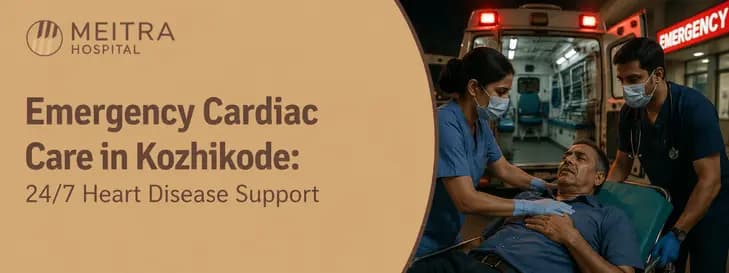

Chest pain rarely announces itself politely. It can arrive as a dull pressure during an ordinary afternoon, a tightness that's easy to blame on gas or fatigue, or a sudden collapse with no warning at all. What separates a good outcome from a tragic one, in almost every case, is how quickly the right kind of medical help is reached, and whether the receiving hospital is genuinely equipped to act the moment the patient arrives.
Cardiovascular disease is now responsible for roughly one in every four deaths in India.
For residents of Kozhikode and the wider Malabar region, this isn't an abstract statistic. It means understanding, in practical terms, what a cardiac emergency looks like, what should happen in the first ten minutes, and what "emergency-ready" actually means when you're choosing where to go. This guide walks through all three.
Why Every Minute Matters: Understanding the "Golden Hour" in a Heart Attack
A heart attack (myocardial infarction) occurs when a coronary artery, one of the vessels feeding blood to the heart muscle itself, becomes blocked, usually by a ruptured plaque and a resulting blood clot. Once blood flow stops, the heart muscle downstream of the blockage begins to die from lack of oxygen. This process is progressive, not instantaneous: the longer the artery stays blocked, the more muscle is lost, and the greater the risk of complications like heart failure, dangerous arrhythmias, or death.
This is the medical basis for the phrase "time is muscle." The goal of emergency cardiac care isn't just to eventually treat the blockage, it's to reopen the artery as fast as safely possible, because every additional minute of blockage converts more living heart tissue into scar tissue that will never fully recover its pumping function.
The Door-to-Balloon Benchmark: 90 Minutes That Decide Outcomes
In hospitals equipped for interventional cardiology, the primary treatment for a severe blockage (STEMI, or ST-elevation myocardial infarction) is a procedure called primary angioplasty, a catheter is threaded into the blocked artery, a balloon is inflated to clear the obstruction, and a stent is usually placed to keep the vessel open.
International cardiology guidelines set a benchmark called "door-to-balloon time": the interval from when a patient walks or is wheeled through the hospital's doors to when the balloon is inflated in the cath lab. The target is 90 minutes or less.
This isn't a theoretical number. A 2026 clinical audit at a tertiary care hospital in India tracked 620 STEMI patients over a 12-month period and found that 91% underwent balloon angioplasty within the recommended 90-minute door-to-balloon window, meeting the international benchmark set by cardiology bodies including the American College of Cardiology and American Heart Association.
Recognising a Cardiac Emergency: Symptoms You Shouldn't Ignore
Not every heart attack looks like the clutch-the-chest scene from television. Symptoms vary by sex, age, and underlying conditions like diabetes, and atypical presentations are exactly the ones that get dismissed as indigestion, fatigue, or muscle strain until it's too late.
| Presentation | Common in | Typical symptoms |
|---|---|---|
| Classic | Men, especially over 45 | Crushing central chest pain or pressure, radiating to left arm/jaw, sweating, breathlessness |
| Atypical | Women, older adults | Unusual fatigue, nausea, upper back or jaw pain, breathlessness without obvious chest pain |
| Silent/masked | People with diabetes (due to nerve damage) | Mild discomfort, breathlessness, sudden weakness, pain may be minimal or absent |
Cardiac Arrest vs Heart Attack: They Are Not the Same Emergency
These two terms are often used interchangeably but describe different events with different immediate responses:
-
Heart attack is a circulation problem, a blocked artery starves part of the heart muscle of blood. The person is usually conscious, breathing, and can often still speak, though in distress.
-
Cardiac arrest is an electrical problem, the heart's rhythm becomes chaotic or stops altogether, and the person collapses, stops breathing normally, and has no pulse. This requires immediate CPR and, if available, an AED (automated external defibrillator), not just a trip to the hospital.
A heart attack can trigger a cardiac arrest, which is exactly why acting fast on heart attack symptoms, rather than waiting to "see if it passes" is so important.
The First 10 Minutes: A Bystander and Patient Action Plan
The first few minutes after a suspected cardiac emergency can have a significant impact on survival and recovery. Knowing exactly what to do, and what to avoid, can help ensure the patient receives life-saving treatment as quickly as possible.
1. Call an Ambulance: Don't Self-Drive
It's a common instinct to bundle a chest-pain patient into a car and drive to the nearest hospital. In almost every case, this is the wrong call. An ambulance staffed with trained paramedics can:
- Start oxygen and initial medication en route
- Perform or transmit an ECG so the receiving hospital's cardiac team is ready before the patient arrives
- Respond immediately with CPR/defibrillation if the patient deteriorates or arrests during transit, something a family member driving cannot safely do
Calling ahead effectively starts the emergency cardiac care pathway before the patient reaches the hospital door.
2. CPR and AED Basics While Help Is on the Way
If someone collapses, is unresponsive, and isn't breathing normally:
- Call for an ambulance immediately (or ask someone nearby to do so).
- Begin chest compressions, push hard and fast in the centre of the chest, at least 100–120 compressions per minute.
- If an AED is available nearby, use it as soon as possible; it will guide you through the steps.
- Continue compressions until paramedics take over.
Bystander CPR, even performed imperfectly, significantly improves survival odds compared to no action while waiting for professional help.


What Makes a Hospital "Emergency-Cardiac-Ready"? A Checklist for Kozhikode Families
When evaluating a hospital for cardiac emergencies, before you need one, ideally, these are reasonable questions to ask:
| Readiness factor | Why it matters |
|---|---|
| 24x7 in-house interventional cardiologist (not on-call from home) | Cuts activation delay for primary angioplasty |
| Cath lab staffed and ready round the clock | Avoids delays waiting for a team to assemble |
| Dedicated cardiac ICU / CCU with continuous monitoring | Post-procedure stability depends on immediate, specialised aftercare |
| NABH/JCI accreditation | Indicates externally audited clinical protocols, not just self-reported standards |
| Dedicated cardiac ambulance fleet | Enables monitored, pre-alerted transport rather than a delayed private vehicle trip |
| Published or auditable door-to-balloon performance | A measurable proxy for real-world emergency readiness |
Meitra Hospital's Approach to Emergency Cardiac Care
When treating a cardiac emergency, speed, coordinated teamwork, and access to advanced technology can significantly influence patient outcomes. Meitra Hospital in Edakkad, Kozhikode, has established its Centre for Heart & Vascular Care to provide rapid assessment and treatment for patients experiencing heart attacks, life-threatening arrhythmias, and other acute cardiac emergencies.
Key features of Meitra's emergency cardiac care infrastructure include:
-
Robotic Hybrid Cath Lab with Dyna CT: The first facility of its kind in South India, designed to support complex cardiac and vascular procedures with high-precision imaging.
-
Advanced coronary imaging: Optical Coherence Tomography (OCT) and Intravascular Ultrasound (IVUS) help cardiologists evaluate coronary artery disease in greater detail during angioplasty and other interventions.
-
Dedicated Electrophysiology (EP) Lab: Specialised for diagnosing and treating abnormal heart rhythms, including complex arrhythmias.
-
3-Tesla Cardiac MRI: Provides detailed imaging for evaluating heart muscle, valves, congenital heart disease, and other structural cardiac conditions.
Beyond technology, Meitra follows internationally recognised quality and safety standards. The hospital is accredited by JCI, NABH, and NABL and has received Green OT certification, reflecting independently audited standards for clinical quality, infection prevention, patient safety, and laboratory services.
Why Meitra Is Regarded Among Kerala's Leading Hospitals for Heart Care
When comparing hospitals for cardiac care, families often look beyond clinical expertise. Factors such as advanced infrastructure, internationally recognised quality standards, affordability, and access to specialised emergency services all play an important role, especially when treatment decisions need to be made quickly.
Kozhikode has become one of Kerala's major healthcare destinations because it combines tertiary and quaternary-level medical facilities with treatment costs that are generally lower than those in many Gulf countries, the UK, or the US. This balance of quality and affordability has made the city a preferred choice for many domestic, NRI, and international patients seeking specialised cardiac care.
Some of the reasons Meitra is frequently considered while comparing heart care hospitals include:
-
Comprehensive tertiary care hospital: A super-specialty hospital with around 220 beds, supported by an expansion plan toward 500 beds.
-
Advanced critical care infrastructure: Equipped with 52 ICU suites and seven operation theatres to support complex cardiac and emergency cases.
-
Modern cardiac technology: Home to a Robotic Hybrid Cath Lab with Dyna CT, along with OCT, IVUS, and a dedicated Electrophysiology (EP) Lab for advanced heart procedures.
-Internationally recognised accreditations: Holds JCI, NABH, and NABL accreditation, demonstrating adherence to independently assessed standards for patient safety and quality of care.
-
Value for Indian and international patients: Offers access to advanced cardiac treatment within Kerala, reducing the need for many patients to travel to metropolitan cities or overseas for specialised procedures.
-
Popular among medical travellers: The combination of advanced infrastructure, accredited care, and Kerala's comparatively lower treatment costs has made Meitra one of the hospitals frequently evaluated by NRI and international patients exploring cardiac care options.
Reducing Your Risk Before It Becomes an Emergency
Most heart attacks don't come from nowhere, they build on years of unmanaged risk factors. Regular screening remains the most effective form of prevention:
- Blood pressure checks at least annually after age 30, more often if you have a family history
- Lipid profile (cholesterol) testing to catch elevated LDL before it causes plaque buildup
- Blood sugar screening, since diabetes both increases heart attack risk and masks its symptoms
- A cardiology consultation if you have a family history of premature heart disease, even without current symptoms
None of this replaces emergency preparedness, but it materially reduces the odds of needing it.
Conclusion
A cardiac emergency is unforgiving of hesitation, but it responds decisively to speed and preparation. Recognising symptoms early, including the atypical ones that are so often missed in women and people with diabetes, calling an ambulance instead of self-driving, and knowing which hospitals in Kozhikode are genuinely equipped with 24x7 interventional cardiology and cath lab readiness can be the difference between a full recovery and irreversible heart damage.
Keep this information somewhere accessible, share it with family members who may need to act on your behalf one day, and use it to make an informed choice about emergency cardiac care before a crisis forces the decision.
If you or a family member are experiencing chest pain or other cardiac symptoms right now, call emergency services immediately, don't wait to read further. For general questions about heart health, cardiology consultations, or Meitra Hospital's cardiac care services, you can chat with our care assistant.
Medical Disclaimer: This article is for general informational purposes only and is not a substitute for professional medical advice, diagnosis, or treatment. If you suspect a cardiac emergency, call your local emergency number or go to the nearest emergency department immediately. Always consult a qualified cardiologist or physician regarding any medical condition.