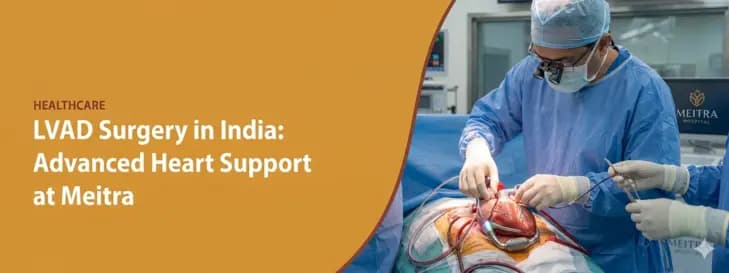

Heart failure is no longer a rare end-stage condition affecting only elderly patients. For patients with advanced heart failure who no longer respond to medications or conventional surgery, a Left Ventricular Assist Device (LVAD) can become the difference between survival and progressive organ failure.
In recent years, India has emerged as a destination for advanced mechanical circulatory support therapies because of its growing cardiac expertise, improved surgical outcomes, and significantly lower treatment costs compared to the US or Europe. Among the centres offering advanced heart failure management in South India, Meitra Hospital in Kozhikode has developed a multidisciplinary cardiac programme that includes LVAD evaluation, implantation, and long-term follow-up care.
This guide explains what LVAD surgery involves, who may need it, expected outcomes, costs in India, risks, recovery, and what patients should realistically expect before considering treatment.
What Is an LVAD?
The left ventricle is the heart's main pumping chamber. In end-stage heart failure, the left ventricle weakens to the point where it cannot push enough blood into the aorta, leading to a cascade of complications affecting every organ in the body.
A Left Ventricular Assist Device (LVAD) is a battery-operated mechanical pump that is surgically implanted inside the chest, just below the heart. It does not replace the heart, rather, it sits alongside it, drawing blood from the left ventricle and pushing it into the aorta, effectively doing the work the weakened ventricle cannot.
Modern LVADs, such as the HeartMate 3, use a continuous-flow centrifugal design. Blood flows smoothly and consistently rather than in pulses. This design has significantly improved outcomes compared to older pulsatile-flow devices, reducing pump thrombosis rates and allowing patients to lead more active lives.
An external controller, worn on a belt or vest, manages the pump settings. The device is powered by batteries or a power module when the patient is at home. The driveline, a cable connecting the internal pump to the external controller, exits through the skin at the abdomen.
Who Is a Candidate for LVAD Surgery?
Patient selection is arguably the most critical step in the entire LVAD journey. Not every heart failure patient is a suitable candidate, and implanting a device in an unsuitable patient carries serious risks. A thorough multidisciplinary evaluation is essential.
Common indications include:
- NYHA Class IIIB or IV heart failure: Patients with severe symptoms at rest or with minimal exertion, despite optimal medical therapy
- Left ventricular ejection fraction (LVEF) below 25%: Indicating severely compromised pumping function
- Cardiogenic shock: Acute deterioration requiring immediate circulatory support
- Dependence on inotropes (IV medications to stimulate heart function): Indicating the heart cannot function without pharmacological support
Three clinical uses of LVAD:
- Bridge to Transplant (BTT): The LVAD supports the patient while they wait on the transplant list, sometimes for months or years. It improves their overall condition, making them a stronger transplant candidate.
- Destination Therapy (DT): For patients who are not eligible for a heart transplant due to age, comorbidities, or other factors, the LVAD is a long-term, permanent solution. Destination therapy has become increasingly common as device technology has matured.
- Bridge to Recovery: In some cases, particularly in younger patients with conditions like myocarditis, the heart can partially recover when offloaded. The LVAD may be removed once the heart regains sufficient function, though this is less common.
Contraindications to consider
Not all patients are suitable. Those with severe irreversible kidney or liver failure, active infection, significant right heart failure (which LVADs can sometimes worsen), or certain coagulation disorders may not benefit and could face worse outcomes with implantation.
This is why the pre-implant evaluation, including right heart catheterisation, echocardiography, and organ function profiling, is so thorough.
The LVAD Implantation Procedure: Step by Step
Understanding what the surgery involves helps patients and families prepare mentally and logistically.
Pre-operative evaluation typically spans several days and includes:
- Transthoracic and transoesophageal echocardiogram
- Right heart catheterisation (to assess pulmonary pressures and right ventricular function)
- Coronary angiography
- CT scan of the chest and abdomen (to plan device positioning)
Comprehensive blood panel, renal and liver function, coagulation studies Psychosocial assessment crucial, as the patient must demonstrate the ability to manage the device at home.
The surgery is performed under general anaesthesia. The chest is opened via a median sternotomy (in most cases), and the patient is placed on cardiopulmonary bypass.
The surgeon sews the inflow cannula into the apex of the left ventricle and connects the outflow graft to the aorta. The pump sits in a pocket created in the upper abdomen. The driveline is tunnelled under the skin and exits at the abdomen. Total operating time is typically 4 to 6 hours depending on prior cardiac surgeries and patient anatomy.
ICU and ward stay:
- Days 1–3: Intensive monitoring in the cardiac ICU. The team watches closely for right heart failure (a known early complication), bleeding, and device function.
- Days 4–10: Transition to a step-down unit. Device education begins patients and a caregiver learn to manage the controller, change batteries, and inspect the driveline exit site.
- Days 10–21: The patient and caregiver must demonstrate competency before discharge. Discharge readiness, not a fixed timeline, determines when the patient goes home.
Life After LVAD: What Patients and Families Need to Know
Living with an LVAD is manageable, but it requires discipline, a committed caregiver, and consistent follow-up.


Device management at home:
- The patient always carries two charged battery packs and a spare controller
- The driveline exit site must be cleaned and dressed daily to prevent infection — one of the leading causes of late LVAD complications
- Device alarms must be understood and acted on correctly
- The patient cannot swim or submerge in water (showers with a driveline cover are permitted)
Activity and quality of life: Most patients experience a significant improvement in exercise tolerance and breathlessness within 4 to 8 weeks. Many return to light work, travel, and social activities. Studies consistently show improvement in NYHA class patients who were bedbound often return to Class II functional status.
Follow-up schedule:
- Weekly INR checks initially, transitioning to every 2 to 4 weeks once stable
- Monthly clinic visits in the first 6 months
- Every 3 months thereafter for device interrogation, echocardiogram, and labs.
LVAD Surgery in India: A Growing and Credible Option
India has seen a meaningful expansion of LVAD programmes over the past decade, driven by growing surgeon expertise, the availability of newer-generation devices, and the reality that donor hearts for transplant remain scarce. For many Indian patients, destination therapy via LVAD is not just a last resort, it is a legitimate and dignified long-term treatment.
What to look for in an LVAD centre in India:
- A dedicated Mechanical Circulatory Support (MCS) programme: not just a hospital that has implanted a few devices, but one with a structured team, protocols, and ongoing follow-up infrastructure
- Right heart catheterisation capability: non-negotiable for pre-implant evaluation
- Cardiac surgery volume: centres with high overall cardiac surgery volume have better outcomes across all complex procedures
- Device education programme: the hospital should have trained LVAD coordinators or nurses who spend dedicated time teaching patients and caregivers
- 24/7 LVAD helpline or on-call support: device alarms at 2 AM are a reality; patients need to reach a knowledgeable clinician immediately
- Heart transplant programme integration: for bridge-to-transplant patients, seamless transition to transplantation requires both programmes to operate under one roof
Meitra Hospital's Approach to LVAD and Advanced Heart Failure
Meitra Hospital, Kozhikode, is a quaternary care hospital in Kerala offering cardiac sciences that include advanced procedures such as LVAD implantation, TAVR, open heart surgery, and multi-organ transplantation.
The Centre for Heart and Vascular Care at Meitra operates as a comprehensive programme, not a standalone surgical unit. It includes a Heart Failure Clinic dedicated specifically to the management of heart failure and its complications, a cardiac ICU, and a Heart and Lung Transplant programme. The transplant programme encompasses heart, lung, and heart-lung transplants, paediatric heart transplants, ventricular assist devices, and ECMO, all operating under the same integrated team.
The hospital's infrastructure includes a Hybrid Catheterisation Lab, 3-Tesla Cardiac MRI Suite, Advanced Robotic Cath Lab with Dyna CT, intravascular ultrasound and optical coherence tomography, and 3D mapping for electrophysiology. These are not decorative features, they directly support the kind of detailed pre-implant evaluation that determines whether a patient is a suitable LVAD candidate and what surgical approach is safest.
What distinguishes Meitra's approach is the multidisciplinary structure: cardiovascular and thoracic surgeons work alongside cardiac intensivists, anaesthesiologists, perfusionists, and a dedicated cardiac rehabilitation team. For LVAD patients specifically, this continuity of care, from evaluation through implantation to long-term device follow-up, is not incidental. It is the programme.
For patients in Kerala, Tamil Nadu, Karnataka, and neighbouring Gulf countries seeking advanced cardiac care within reach, Meitra offers a credible, experienced option without the need to travel to metropolitan cities. Book your consultation today!
Conclusion
End-stage heart failure is one of the most demanding diagnoses a family can face. But it is not always a terminal one. LVADs have extended and improved life for thousands of patients in India and globally patients who were once told nothing more could be done.
The decision to pursue LVAD surgery should never be made quickly or casually. It deserves careful evaluation by a dedicated team, honest conversations about goals of care and quality of life, and a realistic understanding of what living with the device entails. When all those conditions are met, an LVAD can be transformative.
Choosing the right centre matters enormously. Look for a hospital that does not just perform the surgery, but one that stands behind patients through every device alarm, every INR check, and every milestone whether that means bridging to a transplant or supporting life as a long-term therapy.
If you or someone you care for is living with advanced heart failure and want to understand whether LVAD therapy is appropriate, speak with a specialist. Meitra Hospital's cardiac team offers consultations for patients seeking a second opinion or a comprehensive evaluation. Contact us here to speak with our team.