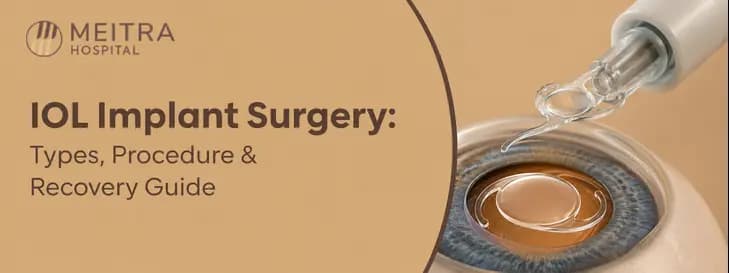

IOL implant surgery replaces your eye's clouded natural lens with an artificial intraocular lens (IOL), restoring clear vision permanently. This outpatient procedure is one of the most commonly performed surgeries worldwide, with millions of patients regaining functional vision every year.
This guide walks through the procedure the way an ophthalmologist would explain it across two or three consultations, what the surgery actually does, the real differences between lens types, what recovery looks like week by week, and the questions that genuinely matter when you're choosing where and how to get it done.
What Is IOL Implant Surgery? (And How It Differs From Cataract Surgery)
An intraocular lens (IOL) is a small, permanent artificial lens placed inside the eye to replace focusing power that the eye has lost. In the overwhelming majority of cases, this happens during cataract surgery: the eye's natural lens has turned cloudy, the surgeon removes it, and an IOL is implanted in its place to restore clear vision.
This is why the terms "cataract surgery" and "IOL implant surgery" are often used interchangeably, the cataract removal and the lens implantation happen in the same sitting, usually through a single procedure called phacoemulsification.
IOLs are also used outside of cataract treatment, in a procedure called refractive lens exchange (RLE), replacing a clear natural lens with an IOL purely to correct very high spectacle power or presbyopia, without a cataract being present.
IOL vs ICL: Clearing Up a Common Confusion
Patients frequently mix up IOLs with ICLs (Implantable Collamer Lenses). They sound similar, but they're not the same procedure. An IOL replaces the eye's natural lens (used in cataract surgery and RLE).
An ICL is added in front of the natural lens without removing it, and is typically used in younger patients with high myopia who aren't candidates for LASIK. If your natural lens is still clear and you're being offered a "lens surgery" in your 20s or 30s, ask specifically which of the two your surgeon means.
Also Read: Refractive Surgery Alternatives: LASIK vs PRK vs ICL Comparison
Who Actually Needs an IOL Implant?
The most common reason, by a wide margin, is age-related cataract, the lens naturally yellows and hardens over the decades, typically becoming visually significant sometime after age 50–60, though diabetes, prolonged steroid use, high myopia, previous eye injury, and family history can bring this forward by years.
Also Read: Corneal Transplant Surgery Explained: Types, Cost, Recovery & Results
Early Warning Signs People Ignore
Because cataract develops gradually, many people adapt without realising how much vision they've lost. The signals worth acting on include:
- Colours looking duller or slightly yellow-tinted than they used to
- Increasing glare from oncoming headlights while driving at night
- Needing brighter light to read comfortably
- Frequent changes in your spectacle prescription within a short span
- A "double vision" effect in one eye that doesn't go away with new glasses
None of these symptoms confirm cataract on their own, they're also seen in glaucoma, diabetic retinopathy, and refractive changes, which is exactly why a dilated eye exam, not self-diagnosis, is the right next step.
Types of IOL Technology and Your Options
IOL technology has evolved dramatically, offering several types to match your lifestyle and visual needs. Your surgeon will recommend the best option based on your eye anatomy, lifestyle, and vision goals. Here is a comparison of common IOL types:
| IOL Type | Best For | Key Benefit |
|---|---|---|
| Monofocal | Distance vision; simple correction | Sharp focus at one distance; durable |
| Multifocal | Both near and distance; reduced glasses dependence | Improved intermediate and near vision |
| Extended Depth of Focus (EDOF) | Wide range of vision distances | Smooth transition across distances; fewer halos |
| Toric | Astigmatism (irregular cornea shape) | Corrects astigmatism; sharper overall vision |
| Accommodating | Natural focusing ability | Mimics your eye's natural lens movement |
Monofocal lenses are the most affordable and durable; most patients use reading glasses for near tasks. Multifocal and EDOF lenses reduce or eliminate the need for glasses but cost more and may cause visual phenomena (halos, glare) in dim light. Toric lenses are essential if you have astigmatism, ensuring clear vision at all distances. Your eye surgeon will discuss which technology aligns with your budget, visual demands, and lifestyle.
The IOL Implant Procedure: Step-by-Step What to Expect
IOL implant surgery is performed as an outpatient procedure, meaning you go home the same day. Here is what happens during your appointment:
Before Surgery
- Your eye doctor performs detailed imaging (biometry) to measure your eye and calculate the correct IOL power for your vision goals.
- You receive numbing eye drops; no general anesthesia is needed.
- Your surgeon marks your eye and reviews the surgical plan with you.
During Surgery
- Your surgeon makes a small incision at the edge of your cornea.
- Using ultrasound energy (phacoemulsification), your surgeon gently breaks up and removes the clouded lens.
- The IOL is inserted through the same incision and positioned inside the lens capsule.
- The incision typically closes on its own without stitches.
After Surgery
You rest briefly and are discharged with antibiotic and anti-inflammatory eye drops. Vision improves over several days to weeks as swelling decreases. Most patients notice clearer vision within 24-48 hours. Your second eye can be done 1-2 weeks later if both eyes need surgery.


Recovery Timeline After IOL Implant Surgery
Recovery is generally faster than people expect, but it happens in stages rather than all at once:
Day 1–7: Prescribed antibiotic and anti-inflammatory eye drops are used strictly on schedule; mild blurring and light sensitivity settle within the first few days for most patients.
Week 2–4: Most people resume driving, reading, and screen use once the surgeon confirms healing on follow-up; strenuous exercise, swimming, and eye rubbing are usually restricted through this window.
Month 1–3: Vision typically stabilises fully, and any residual glasses prescription (especially for near work with a monofocal lens) is finalised.
IOL Implant Surgery Cost in India: What Actually Drives the Price
Cost varies widely because cataract surgery isn't one fixed-price procedure, it depends on the surgical technique, IOL selected, surgeon fees, facility charges and follow-up care.
Currently cataract surgery in India at around ₹25,000–₹65,000 per eye, while its broader cost data shows prices can range from approximately ₹18,000 to ₹1,20,000 depending on the procedure and individual factors.
Premium IOLs can add substantially to the cost; Lybrate lists approximate IOL prices ranging from ₹5,000–₹20,000 for monofocal lenses, ₹25,000–₹50,000 for toric lenses and ₹15,000–₹90,000 for multifocal lenses. The variables that actually move the final number are:
-
Lens type: Monofocal is the most affordable; multifocal, toric, and EDOF lenses cost more due to added optical technology.
-
Surgical technique: Standard phacoemulsification vs. femtosecond laser-assisted surgery (FLACS).
-
Hospital and city: Metro private hospitals typically price higher than smaller towns or government facilities.
-
Insurance and schemes: Many health insurance policies cover standard monofocal IOL surgery, and government schemes like Ayushman Bharat subsidise cataract surgery at empanelled hospitals, though premium lens upgrades are usually an out-of-pocket difference.
It's worth asking your hospital for an itemised estimate, separating surgeon's fee, lens cost, pre-op tests, and follow-up visits, rather than a single bundled number, so you know exactly what you're paying for.
How to Choose the Right IOL and Surgeon
Beyond the lens itself, a few practical questions are worth asking at your consultation:
- How many years has this specific surgeon been performing IOL implantation, and roughly how many procedures a year?
- What biometry technology does the centre use?
- What happens if the initial lens power calculation needs a follow-up correction?
And critically, is the recommendation being tailored to your actual lifestyle (driving at night, computer use, reading habits, sports), or is it a default recommendation regardless of who's in the chair?
A good consultation should feel more like a conversation about your daily vision needs than a lens sales pitch.
Also Read: Medical Tourism to Kerala: What Gulf Patients Need to Know Before Choosing a Hospital in India
Why Patients Across Kerala and Abroad Choose Meitra Hospital for Eye Care
Meitra Hospital, Kozhikode offers ophthalmology care supported by detailed pre-operative assessment and modern diagnostic facilities.
-
Comprehensive eye evaluation: Includes Humphrey Field Analyzer perimetry, non-contact tonometry, autorefractometry, keratometry, slit-lamp examination and A-scan biometry.
-
Multiple IOL options: Patients can be evaluated for monofocal, multifocal, toric and EDOF lenses, allowing lens selection based on vision needs and eye measurements.
-
Related eye-care services: Cataract and IOL procedures are supported alongside services such as LASIK and glaucoma management.
-
Tertiary-care support: As a NABH-accredited multispeciality hospital, Meitra can provide coordinated care when patients require broader medical support.
-
Kerala and international patients: The hospital also caters to NRI and international patients, with treatment coordination and language-support services.
For anyone comparing hospitals, key questions to ask include what biometry technology is used, how IOL power is calculated, which lens options are available, and who will manage follow-up after surgery.
Conclusion
IOL implant surgery has quietly become one of modern medicine's most reliable procedures, routine enough to be done as day care, precise enough that outcomes can be predicted years in advance, and varied enough in lens options that "one size fits all" genuinely doesn't apply anymore.
The decision that matters most isn't whether to have the surgery, for most people with a visually significant cataract, that answer becomes obvious on its own, it's choosing the right lens for how you actually live, and the right surgical team to measure and place it accurately.
A clear-eyed conversation with your ophthalmologist, armed with the questions in this guide, is the best next step.
Every eye is different, and lens selection genuinely depends on your specific vision, astigmatism, and daily habits.
Chat with our care assistant to get your questions answered, or book a consultation with Meitra Hospital's Ophthalmology team to discuss which IOL fits your needs.
Medical Disclaimer: This article is intended for general informational and educational purposes only and does not constitute medical advice. It is not a substitute for professional diagnosis, consultation, or treatment by a qualified ophthalmologist. Individual eye conditions, lens recommendations, and surgical outcomes vary from person to person. Please consult a qualified eye care specialist to evaluate your specific condition before making any treatment decisions.