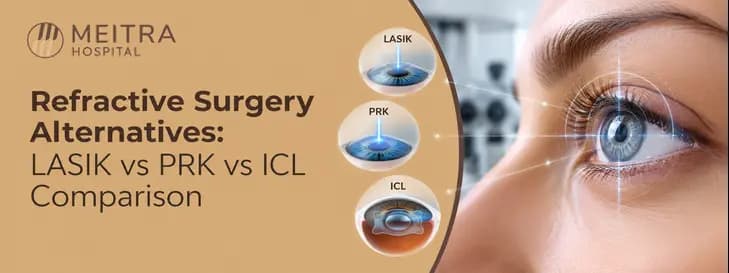

If you wear glasses or contact lenses and want clearer vision without daily correction, refractive surgery might interest you. Three popular options, LASIK, PRK, and ICL, offer different approaches to reshaping your eye or placing an implant inside it.
This guide breaks down how LASIK, PRK, and ICL actually differ, mechanically, in recovery, and in long-term outcomes, using registry data, peer-reviewed outcome studies, and real candidacy criteria, so you can walk into a consultation asking the right questions instead of picking the procedure your neighbour happened to get.
What Are the Main Refractive Surgery Options Available Today?
Refractive surgery corrects how your eye focuses light, reducing or eliminating your need for glasses or contacts. Your eye's cornea and lens bend light rays to focus them on the retina, a light-sensitive tissue at the back of your eye. When this focusing process is off, you develop refractive errors, myopia (nearsightedness), hyperopia (farsightedness), or astigmatism (blurred vision at all distances).
Three widely accepted surgical approaches address these errors: LASIK (laser-assisted in situ keratomileusis), which reshapes the inner cornea; PRK (photorefractive keratectomy), which reshapes the outer cornea surface; and ICL (implantable collamer lens), which places a prescription lens inside your eye.
Each method has distinct advantages, recovery timelines, and suitability based on your eye anatomy, prescription strength, and lifestyle. The choice depends on factors like corneal thickness, dry eye tendency, and your profession or hobbies.
LASIK: The Fast-Recovery Standard
For patients who meet the necessary corneal and eye-health criteria, LASIK remains a widely used option because it combines precise laser correction with rapid visual recovery.
How the Flap-Based Procedure Works
LASIK (Laser-Assisted in Situ Keratomileusis) creates a thin, hinged flap in the outer cornea, folds it back, reshapes the underlying corneal tissue with an excimer laser, and repositions the flap, which self-adheres without stitches. Because the flap protects the deeper corneal layers and heals quickly, most patients notice clearer vision within 24 hours.
Who Actually Qualifies
Candidacy depends on corneal thickness (pachymetry), at least a year of stable refraction, adequate tear film, and a refractive error within the range a laser can safely correct. Not everyone who walks in for a consultation walks out eligible.
Recovery Timeline and Risk Profile
Most LASIK patients achieve functional vision within a day and return to non-strenuous work within 2–3 days. The 2026 IRIS Registry study found dry eye disease was the most frequent postoperative complication for both procedures, occurring in 16.1% of LASIK eyes across the full follow-up period, though LASIK carried a lower dry-eye incidence than PRK specifically in the 1–3-month window, and lower ocular pain incidence at 3–12 months (ScienceDirect, 2026). Flap-related complications, such as dislocation or epithelial ingrowth, remain a LASIK-specific risk that simply doesn't exist with PRK or ICL.
PRK: Surface Ablation for Thinner or Higher-Risk Corneas
For patients who may not be ideal candidates for LASIK, PRK provides a flap-free approach that preserves more corneal tissue while still correcting refractive errors with laser technology.
How PRK Differs Mechanically
Photorefractive Keratectomy skips the flap entirely. The surgeon removes the thin outer epithelial layer of the cornea, which regenerates naturally, then reshapes the corneal surface with the same excimer laser used in LASIK. Because no flap is cut, PRK preserves more of the cornea's structural biomechanics and removes any lifelong risk of flap dislocation, a meaningful advantage for contact-sport athletes or patients with borderline corneal thickness.
The Real Recovery Timeline
This is where PRK's reputation and reality diverge most. The epithelium takes roughly 3–5 days to regrow, during which vision is hazy and eyes are light-sensitive and uncomfortable; full visual stabilisation typically takes 1–4 weeks, sometimes longer.
Who PRK Suits Best
Patients with thinner-than-average corneas, mild irregularities on corneal topography, or professions and hobbies with a real risk of eye trauma are frequently steered toward PRK over LASIK for exactly this reason: trading a harder first week for one fewer structural risk down the line.
ICL: The Reversible, Non-Corneal Alternative
For patients seeking vision correction without removing corneal tissue, ICL offers a different approach, making it particularly suitable for certain refractive profiles.
How an Implantable Collamer Lens Works
Unlike LASIK and PRK, ICL doesn't reshape the cornea at all. A biocompatible collamer lens is implanted between the iris and the eye's natural lens through a small incision, correcting refractive error much like a permanent, invisible contact lens would. Because no corneal tissue is removed, the procedure is reversible, the lens can be exchanged or removed if a patient's vision or eye health needs change later.
Ideal Candidates
ICL is generally the go-to alternative for patients who don't qualify for LASIK or PRK: those with very high myopia beyond what laser correction can safely treat (up to roughly −18.00 D), thin or irregular corneas, or chronic dry eye disease that laser ablation would likely worsen. It also sidesteps the corneal biomechanical concerns surgeons weigh carefully in very thin corneas.


Comparing Recovery Time, Results, and Side Effects
Each refractive surgery differs in recovery speed, permanence, and risk profile. The table below summarizes key differences:
| Aspect | LASIK | PRK | ICL |
|---|---|---|---|
| Vision Recovery | 24-48 hours | 1-3 weeks | Days to 1 week |
| Final Stability | 3-6 months | 3-6 months | Immediate |
| Corneal Changes | Reshapes interior | Reshapes surface | No corneal change |
| Reversibility | Irreversible | Irreversible | Reversible |
| Common Side Effects | Temporary dry eyes, glare/halos | Discomfort during healing, dry eyes | Rare: cataract, glaucoma, cell loss |
| Best for | Moderate myopia, active lifestyle | Thin corneas, contact sports | High myopia, reversibility preference |
| Corneal Thickness Required | Minimum 500 micrometers | Slightly less critical | Not applicable |
All three procedures have high satisfaction rates when candidates are carefully selected. LASIK offers the fastest return to normal vision, making it popular among busy professionals. PRK provides excellent long-term stability with no corneal flap concerns.
ICL gives high myopic patients a durable, reversible option when corneal surgery is not suitable.
Dry eyes, glare, or temporary visual fluctuations can occur with any procedure but usually resolve within weeks to months. Your ophthalmologist will discuss realistic expectations during your pre-operative consultation.
How Surgeons Actually Choose Between the Three
Rather than a preference call, candidacy is decided by measurable factors most patients never see spelled out on a hospital brochure:
-
Corneal thickness (pachymetry): determines how much tissue can safely be removed for LASIK or PRK.
-
Degree and stability of refractive error: very high myopia often exceeds laser correction limits, pointing toward ICL.
-
Corneal topography: irregularities can rule out LASIK specifically, without ruling out PRK or ICL.
-
Pupil size and anterior chamber depth: relevant to night-vision quality and to ICL sizing.
-
Tear film and dry eye status: a laser procedure on an already-dry eye tends to compound the problem.
-
Lifestyle and occupation: contact sports, borderline corneal thickness, or professions like the military or aviation shift the calculus.
-
This is exactly why an in-person diagnostic workup: not a symptom checklist read online, is the only reliable way to know which of the three procedures actually applies to a given patient.
Meitra Hospital's Approach to Refractive Surgery Alternatives
At Meitra Hospital’s Department of Ophthalmology in Kozhikode, the choice between LASIK, PRK, and ICL is based on individual eye health and diagnostic findings, not a one-size-fits-all approach. A comprehensive pre-surgical evaluation includes corneal assessment, refractive measurements, intraocular pressure testing, biometry, keratometry, and slit-lamp examination.
LASIK is offered as a day-care procedure for suitable candidates. Patients who may not be ideal for LASIK due to thinner corneas, high myopia, or dry eye can be evaluated for alternatives such as PRK or ICL.
With a multidisciplinary hospital setup, in-house diagnostics, and access to experienced specialists, Meitra also supports NRI and international patients seeking refractive surgery in Kerala.
The right procedure starts with the right diagnosis. A detailed ophthalmology consultation can help determine which vision-correction option is most appropriate for your eyes.
Conclusion
LASIK, PRK, and ICL solve the same underlying problem, refractive error, through three genuinely different mechanisms, each with its own recovery timeline, risk profile, and candidacy requirements.
The 2026 IRIS Registry data make clear that LASIK and PRK aren't interchangeable even when their final visual outcomes look similar on paper, and five-year ICL data show that reversibility doesn't come at the cost of long-term stability.
The right choice isn't the procedure that's most talked about online, it's the one your cornea, refractive error, and lifestyle actually support, and that's a determination a proper diagnostic workup makes, not a comparison article.
Chat with Meitra's virtual assistant for quick answers to common questions, or to book a diagnostic consultation and get a procedure recommendation based on your own eye data, not a generic checklist.
Medical Disclaimer: This article is intended for general informational purposes only and does not constitute medical advice. Refractive surgery candidacy, procedure suitability, and outcomes vary by individual and can only be determined through an in-person clinical evaluation by a qualified ophthalmologist. Please consult a licensed medical professional before making any decisions about LASIK, PRK, ICL, or any other treatment.