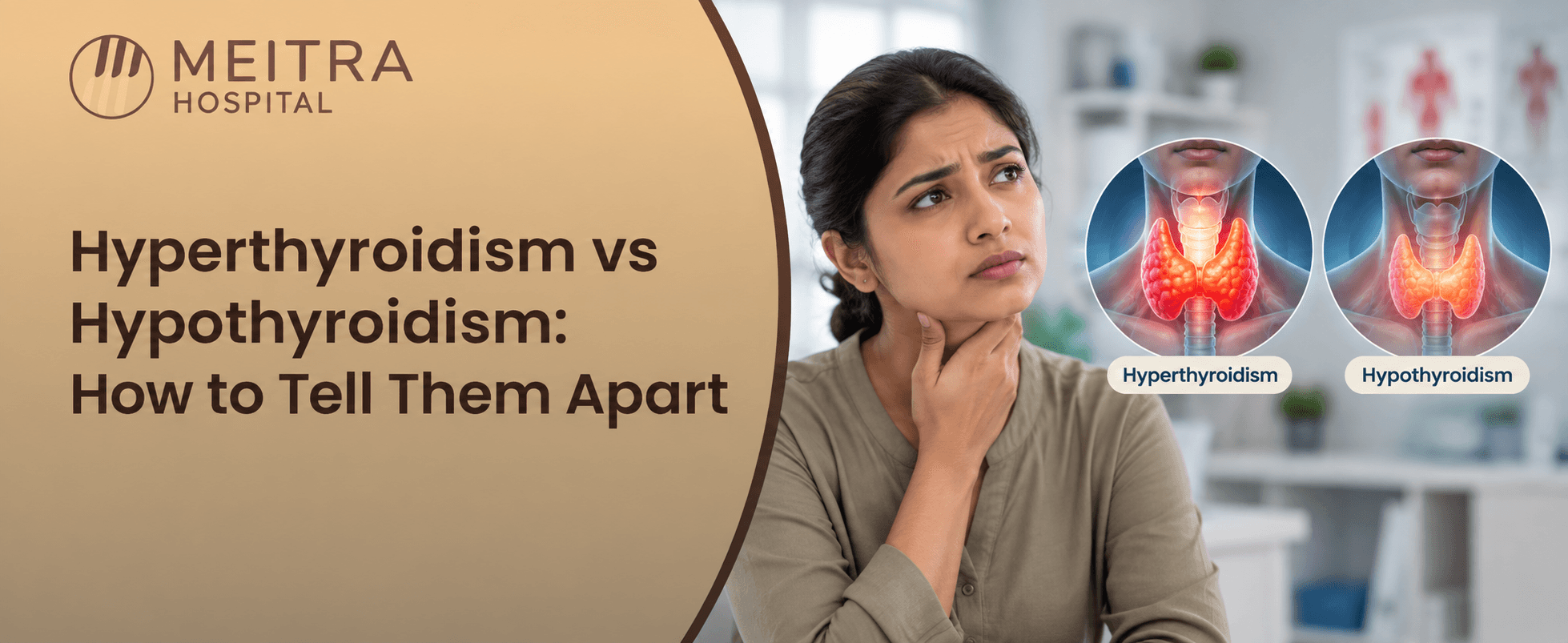

Hyperthyroidism and hypothyroidism are two opposite thyroid disorders. Hyperthyroidism occurs when the thyroid produces excess hormones, often causing weight loss, rapid heartbeat, sweating and anxiety, while hypothyroidism results from too little hormone, commonly causing weight gain, fatigue, feeling cold and dry skin.
Some symptoms can overlap, making the two difficult to distinguish by symptoms alone. This guide explains their key differences, causes, symptoms, diagnosis and treatment options so you can understand when thyroid testing may be needed.
What Is Hyperthyroidism?
Hyperthyroidism means the thyroid gland is producing more thyroxine (T4) and triiodothyronine (T3) than the body needs. Because these hormones set the body's metabolic rate, an excess speeds nearly every system up, heartbeat, digestion, even how quickly the body burns through calories at rest.
Common causes include:
-
Graves' disease, an autoimmune condition in which antibodies (TRAb) overstimulate the thyroid; this is the leading cause of hyperthyroidism in iodine-sufficient regions, including most of India.
-
Toxic multinodular goitre or a toxic adenoma, nodules on the thyroid that independently produce hormone, regardless of what the body actually needs.
-
Thyroiditis, inflammation that causes hormone already stored in the gland to leak into the bloodstream; this form is often temporary.
-
Excess iodine intake, certain medications (such as amiodarone, used for heart rhythm problems), or taking more thyroid hormone replacement than prescribed for an existing hypothyroidism diagnosis.
What Is Hypothyroidism?
Hypothyroidism is the reverse problem: the thyroid produces too little hormone, so the body's processes slow down, metabolism, heart rate, digestion, and cognitive sharpness can all be affected.
Common causes include:
-
Hashimoto's thyroiditis, an autoimmune condition where the immune system gradually attacks and damages the thyroid gland; this is the most common cause of hypothyroidism worldwide and in India.
-
Iodine deficiency, still clinically relevant in parts of India, particularly in hilly and inland regions away from the coast.
-
Treatment for hyperthyroidism itself, radioactive iodine therapy or surgical removal of the thyroid can leave the gland permanently underactive afterward.
-
Pituitary or hypothalamus dysfunction (secondary hypothyroidism), and congenital hypothyroidism, which is present from birth and screened for in newborns.
Hyperthyroidism vs Hypothyroidism: Symptom Comparison
Because one condition speeds the body up and the other slows it down, most symptoms run in opposite directions by body system:
| Body System | Hyperthyroidism (Overactive) | Hypothyroidism (Underactive) |
|---|---|---|
| Weight | Unexplained weight loss despite normal or increased appetite | Unexplained weight gain |
| Heart rate | Rapid or irregular heartbeat, palpitations | Slower-than-usual heart rate |
| Energy | Restlessness, difficulty sleeping, nervous energy | Persistent fatigue, sluggishness |
| Temperature | Feeling hot, excess sweating | Feeling cold, sensitive to cold |
| Skin & hair | Warm, moist skin; fine, brittle hair | Dry skin; coarse, thinning hair |
| Digestion | Frequent bowel movements or diarrhoea | Constipation |
| Mood | Anxiety, irritability | Low mood, depression-like symptoms |
| Menstrual cycle | Lighter or irregular periods | Heavier or irregular periods |
| Eyes / neck | Bulging eyes and visible goitre (typical of Graves' disease) | Puffy face; goitre can occur in iodine deficiency or Hashimoto's |
Why the Two Get Mistaken for Each Other
Both conditions can cause fatigue, muscle weakness and mood changes, just for different underlying reasons, which is exactly why a blood test, not symptoms alone, is needed to tell them apart.
A patient with hyperthyroidism may feel tired because the body is running in overdrive and cannot sustain the pace; a patient with hypothyroidism feels tired because everything, including energy production itself, has slowed down. Doctors don't rely on how a symptom feels but on what the underlying TSH, T3 and T4 values show, since the same word, 'fatigue' or 'irregular periods', can point in either direction.
How Doctors Tell the Two Apart
A single blood test usually settles the direction of the problem, though confirming the exact cause typically needs one or two follow-up tests:
| Test | What It Measures | What the Result Suggests |
|---|---|---|
| TSH (Thyroid-Stimulating Hormone) | Pituitary signal to the thyroid | Low TSH points to hyperthyroidism; high TSH points to hypothyroidism |
| Free T4 / Free T3 | Actual circulating thyroid hormone | High levels confirm hyperthyroidism; low levels confirm hypothyroidism |
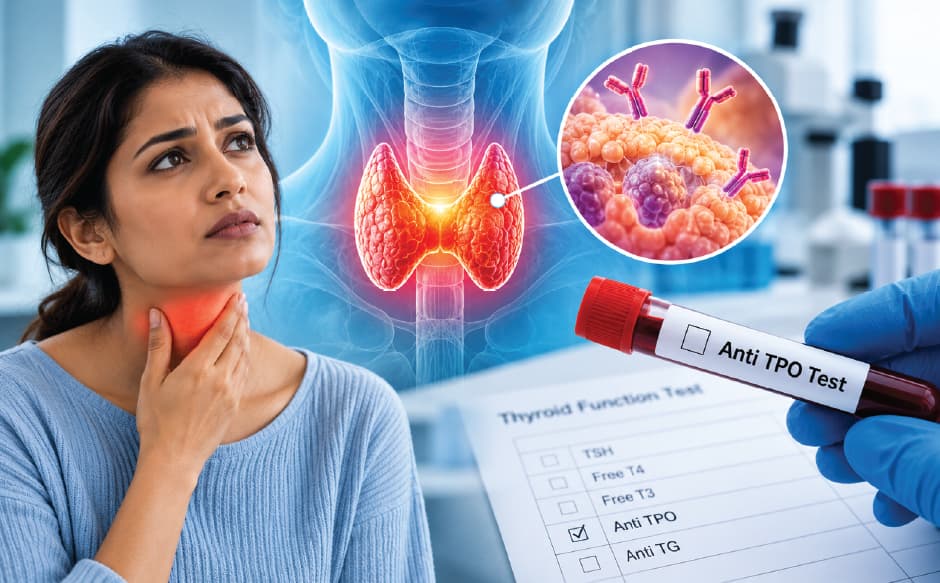
| Anti-TPO antibodies | Autoimmune marker | Elevated in Hashimoto's thyroiditis |
| TRAb (TSH-receptor antibodies) | Autoimmune marker specific to Graves' | Elevated in Graves' disease |
| Thyroid ultrasound / uptake scan | Gland structure and hormone-producing activity | Identifies nodules, goitre size, or an inflammation pattern |
TSH is usually the starting point because it is the most sensitive early indicator; if it comes back abnormal, doctors follow up with T3/T4 and antibody tests to confirm the exact cause, since treatment for Graves' disease looks very different from treatment for a toxic nodule, even though both cause hyperthyroidism.
Treatment: Why the Two Are Managed Differently
| Factors | Hyperthyroidism | Hypothyroidism |
|---|---|---|
| Primary treatment | Anti-thyroid medication (methimazole, carbimazole) to reduce hormone production | Daily levothyroxine to replace the missing hormone |
| Other options | Radioactive iodine therapy; surgery (thyroidectomy) in select cases | Dose adjustment guided by periodic TSH monitoring; addressing an underlying cause where relevant |
| Monitoring | Regular TSH/T3/T4 checks; eye evaluation if Graves'-related eye disease is present | TSH checks roughly every 6-8 weeks after a dose change, then annually once stable |
| Typical duration | Can be short-term (e.g., once thyroiditis resolves) or lifelong (Graves', post-surgical) | Usually lifelong, especially with autoimmune or post-surgical causes |
Neither condition should be self-managed with over-the-counter supplements or unsupervised dose changes. Taking more thyroid replacement than prescribed can itself trigger hyperthyroid symptoms, and stopping anti-thyroid medication abruptly can trigger a dangerous flare known as thyroid storm.


Left Untreated: What's at Stake
Both conditions carry real long-term risk if ignored, though the risks develop differently:
-
Untreated hyperthyroidism can lead to atrial fibrillation, weakened bones (osteoporosis), and, in rare, severe cases, a life-threatening thyroid storm.
-
Untreated hypothyroidism can raise LDL cholesterol and heart disease risk, contribute to infertility and pregnancy complications, and in extreme, longstanding cases progress to myxedema coma.
Both directions are also linked to fertility difficulties and pregnancy complications, which is one reason thyroid screening is now recommended for many women trying to conceive, regardless of which direction their thyroid eventually turns out to be tilted.
Managing a Thyroid Diagnosis Day to Day
Whichever direction your thyroid has tipped, a few practical habits make a measurable difference alongside medication:
-
Take levothyroxine on an empty stomach at a consistent time, away from calcium, iron supplements and coffee, all of which can blunt absorption.
-
Don't skip follow-up TSH tests once you start feeling better, dosing often needs adjustment over time, especially after weight change, a change in medication, or during pregnancy.
-
For hyperthyroidism, moderate caffeine and stimulant intake, since both can worsen palpitations and anxiety-type symptoms.
-
Track your own symptom pattern, weight, resting heart rate, sleep, bowel habits, between visits; endocrinologists rely on this trend data as much as lab values to fine-tune a treatment plan.
-
Avoid iodine-heavy supplements or contrast dyes without medical clearance if you have a known thyroid nodule or an autoimmune thyroid condition.
Why Patients in Kerala and Beyond Choose Meitra for Thyroid Care
Getting from "something feels off" to a confirmed diagnosis usually takes more than one blood test, which is where a hospital's internal coordination matters almost as much as the diagnosis itself. At Meitra Hospital's Centre for Endocrinology and Metabolic Disease in Kozhikode, thyroid function tests, antibody panels and ultrasound imaging are processed through an in-house lab and diagnostics team, so patients typically leave with a confirmed direction, hyperthyroid or hypothyroid, and a treatment plan discussed on the same day, rather than being sent out for tests across multiple clinics.
The department, also coordinates with Meitra's in-house dietetics team for patients whose thyroid condition intersects with weight management, diabetes, or pregnancy, a link that matters because thyroid disorders rarely exist in isolation from a patient's broader metabolic health.
Meitra Hospital is NABH and NABL accredited, and its diagnostic and treatment costs are structured to be considerably more affordable than comparable centres in the Gulf, Southeast Asia, or the West, a factor that has made it a regular stop for NRI and international patients from the Gulf region combining a Kozhikode family visit with an endocrinology consultation. For patients across Kerala, the appeal is simpler: a full thyroid work-up, specialist opinion, and treatment plan available on one hospital campus, without being referred out for basic testing.
If your recent blood work shows an abnormal TSH, or you're noticing a cluster of the symptoms described above, a consultation with Meitra's endocrinology team can help confirm which condition you're dealing with and start the right treatment path early.
Conclusion
Hyperthyroidism and hypothyroidism sit on opposite ends of the same gland's malfunction, one speeds the body up, the other slows it down, but both are manageable once correctly diagnosed. The overlap in early symptoms is exactly why guesswork is risky: a TSH test costs little and settles the direction in one visit, while confirming the specific cause, Graves' disease, Hashimoto's thyroiditis, or a nodule, usually needs a short follow-up panel.
Given how common thyroid dysfunction is across India, and how treatable it is once identified, persistent fatigue, unexplained weight change, or a noticeable shift in heart rhythm are worth a thyroid check rather than being written off as stress or age.
If you're experiencing unexplained fatigue, weight changes, or heart rhythm shifts, don't wait for symptoms to escalate. Contact Meitra Hospital's Centre for Endocrinology and Metabolic Disease to book a consultation, or Chat with our medical Assistant for quick guidance on your next step.
Medical Disclaimer: This article is intended for general informational purposes only and does not constitute medical advice. Thyroid conditions require diagnosis and treatment tailored to an individual's health history. Please consult a qualified endocrinologist or physician for personal medical guidance.