
For many couples, the journey to parenthood flows naturally. Yet for others, conceiving requires medical support. IVF (in-vitro fertilisation) has become a transformative option for millions worldwide, offering hope when natural conception faces barriers.
The honest answer isn't "IVF is better" or "natural is safer." It's that the two paths solve different problems, work best under different circumstances, and the right choice depends on your age, your diagnosis (if any), and how long you've already been trying.
This guide breaks down what actually happens in each process, what the real success-rate data shows by age, what IVF costs in India today, and, just as importantly, when a fertility work-up makes more sense than either "waiting it out" or jumping straight to treatment.
What Happens During Natural Conception
Natural conception depends on a tightly timed sequence: an egg is released during ovulation, survives for roughly 12–24 hours in the fallopian tube, and must meet healthy sperm (which can survive in the reproductive tract for up to five days) within that window for fertilization to occur. The fertilized egg then travels to the uterus and implants, a process that takes about a week on its own, with no external monitoring or intervention.
What Happens During an IVF Cycle
In vitro fertilization compresses and controls the same biological steps that natural conception leaves to chance.
-
Ovarian stimulation (roughly days 1–12): Daily hormone injections encourage the ovaries to mature multiple eggs instead of the usual one, with follicle growth tracked through blood tests and ultrasounds.
-
Egg retrieval: Once follicles reach the right size, a short, sedated procedure retrieves the eggs directly from the ovaries.
-
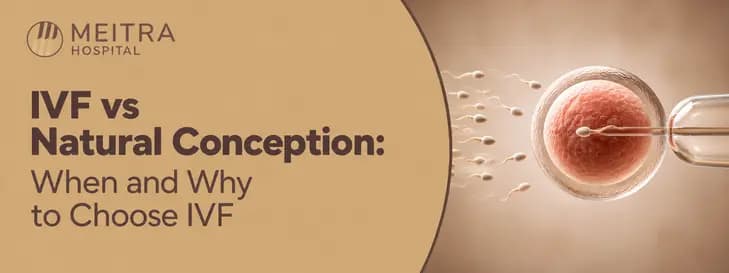
Fertilization in the lab: Eggs are combined with sperm in a culture dish, or where sperm quality is a factor, a single sperm is injected directly into each egg (ICSI). Embryos are cultured for 3–5 days.
Embryo transfer: One embryo (occasionally two, depending on age and history) is placed into the uterus, followed by a roughly two-week wait before a blood pregnancy test.
Every stage that natural conception leaves to biology, egg count, fertilization, embryo quality, is visible and, to some extent, manageable in an IVF cycle. That's the core trade-off: less unpredictability, more medical involvement.
IVF vs Natural Conception: Success Rates by Age
Age is the variable that affects both pathways more than any other factor, and it affects them similarly, because both ultimately depend on egg quality and quantity.
| Age Group | Natural Conception (chance per cycle) | IVF (live birth rate per egg retrieval, own eggs) |
|---|---|---|
| Under 35 | 20–25% | ~50% |
| 35–37 | 15–20% | ~36% |
| 38–40 | 10–15% | ~23% |
| 40+ | Under 5–10% | ~8% |
7 Real Differences Between IVF and Natural Conception
While both pathways can lead to a healthy pregnancy, they differ significantly in how conception is timed, monitored, managed, and how much control the medical team has over the process.
| Factor | Natural Conception | IVF |
|---|---|---|
| Timing control | None, depends on spontaneous ovulation | Fully scheduled and monitored |
| Medical supervision | Minimal, unless complications arise | Continuous (bloodwork, scans, lab work) |
| Cost per attempt | Effectively none | ₹1.2–2.5 lakh per cycle in India |
| Genetic screening | Not possible | Optional (PGT-A) before transfer |
| Physical/emotional demands | Low | Moderate–high (injections, appointments, waiting) |
| Multiple pregnancy risk | Low (~1–2%) | Higher with multi-embryo transfer, lower with single-embryo protocols |
| Predictability of outcome | Low | Higher, but never guaranteed |


When Should You Actually Consider IVF?
IVF isn't the automatic "next step" after a few disappointing months, it's a specific answer to specific problems:
-
Diagnosed structural or medical causes: blocked or damaged fallopian tubes, severe male-factor infertility (very low sperm count or motility), moderate-to-severe endometriosis, or diminished ovarian reserve.
-
Unexplained infertility persisting beyond the evaluation window 12 months under 35, 6 months at 35+, after basic testing (hormone panel, semen analysis, tubal patency check) hasn't identified a clear cause treatable with simpler methods like ovulation induction or IUI.
-
Age-related decline where time itself is the limiting factor and further "waiting" reduces the odds more than treatment would.
-
Fertility preservation returns: using previously frozen eggs or embryos.
-
Same-sex couples and single parents by choice, for whom IVF (often with donor gametes) is the direct route to parenthood rather than a "last resort."
If none of these apply and you're under 35 with no red-flag symptoms (irregular cycles, painful periods, known PCOS, prior pelvic surgery or infection), continuing to try naturally while tracking ovulation is still the evidence-based first step, but a baseline fertility check-up rarely hurts and often shortens the road either way.
Also Read: Natural Cycle IVF vs Stimulated IVF: Which Is Right for You?
What IVF Actually Costs in India
Cost is often a deciding factor alongside biology. In India, a single IVF cycle typically costs around ₹1.2 lakh to ₹2.5 lakh, although the final amount varies by city, clinic, treatment complexity, medications, and additional procedures. Costs may increase when treatments such as ICSI, embryo freezing, or other laboratory services are required.
What's rarely factored into the "natural is free" assumption is the cost of time. Prolonged attempts without a fertility evaluation can delay the diagnosis of problems such as blocked fallopian tubes, ovulation disorders, or male-factor infertility. Earlier assessment does not necessarily mean IVF; in some cases, identifying the underlying problem can allow a simpler treatment to be considered first.
4 Myths About IVF vs Natural Conception, Corrected
IVF is often surrounded by misconceptions about its success, risks, and relationship with natural fertility. Here are four common myths, along with what the evidence actually shows:
-
Myth: IVF guarantees a baby. It significantly improves the odds at a given age, but no cycle — IVF or natural, guarantees a live birth. Success is expressed in probabilities, not certainties, at every stage.
-
Myth: Trying naturally has no downside. Time itself is a variable. Every year of unmonitored trying past the recommended evaluation window is a year in which age-related decline continues regardless of method.
-
Myth: IVF babies have worse long-term health outcomes. The overwhelming majority of IVF pregnancies result in healthy, typically developing children; most risk differences that do exist (e.g., slightly higher rates of preterm birth or low birth weight) are linked more to underlying infertility causes, maternal age, and multiple pregnancies than to the IVF process itself.
-
Myth: Once you're doing IVF, age stops mattering. As the age-wise table above shows, IVF success rates decline with age in the same direction as natural fertility, because both depend on egg quality. IVF changes the odds at a given age; it doesn't remove age from the equation.
How Meitra Hospital Approaches Fertility Care in Kozhikode
At Meitra Hospital’s Department of Obstetrics & Gynaecology, fertility care begins with identifying the reason conception has been difficult rather than immediately moving towards assisted reproduction.
The evaluation is tailored to the couple and may include pelvic ultrasound, assessment of ovulation and ovarian function, hormonal testing, semen analysis, and procedures such as hysteroscopy when indicated. This helps the team determine whether the next step should be lifestyle or medical management, ovulation induction, IUI, or IVF.
The approach is particularly useful when several factors may be contributing simultaneously. For example:
-
Irregular ovulation: Conditions such as PCOS may require targeted ovulation management before IVF is considered.
-
Tubal or uterine factors: Ultrasound and hysteroscopy can help identify structural problems that may affect implantation or conception.
-
Male-factor infertility: Semen evaluation helps determine whether treatment should address sperm-related factors, IUI, or assisted reproduction.
-
Hormonal conditions: Thyroid and other endocrine issues can be assessed and managed alongside fertility treatment.
Meitra Hospital is accredited by JCI, NABH, and NABL, with its fertility and gynaecology services supported by specialists across endocrinology, urology, and radiology. This multidisciplinary setup can be valuable when infertility involves conditions outside reproductive health alone.
For couples from Kozhikode, elsewhere in India, or overseas, the emphasis is therefore on matching treatment intensity to the clinical findings. The goal is not simply to offer IVF, but to identify the most appropriate route to pregnancy based on the couple’s diagnosis, reproductive goals, and individual circumstances.
Conclusion
IVF and natural conception aren't competing philosophies, they're two different tools that work best under different conditions, and both are governed more by age and underlying diagnosis than by personal preference. The data is consistent: under 35, natural conception still offers a reasonable monthly chance, and IVF roughly doubles the odds per attempt when medically indicated.
Past 35, both pathways decline together, which is why the real decision point isn't "IVF vs. natural" in the abstract, it's whether you've reached the 12-month (or 6-month, if 35+) mark without success, and whether a proper diagnostic work-up has actually been done. Getting that evaluation early, regardless of which path it points you toward, is the single most useful thing most couples can do.
You don't have to figure this out from statistics alone. Chat with Meitra Hospital's medical assistant for guidance on next steps, or to book a fertility consultation with the Obstetrics & Gynaecology team in Kozhikode.
Medical Disclaimer: This article is for general informational purposes only and does not constitute medical advice, diagnosis, or treatment. Success rates, costs, and timelines cited are population-level averages from the sources linked above and will vary based on individual health history, diagnosis, and clinic protocols. Please consult a qualified fertility specialist or gynaecologist for evaluation and treatment recommendations specific to your situation.