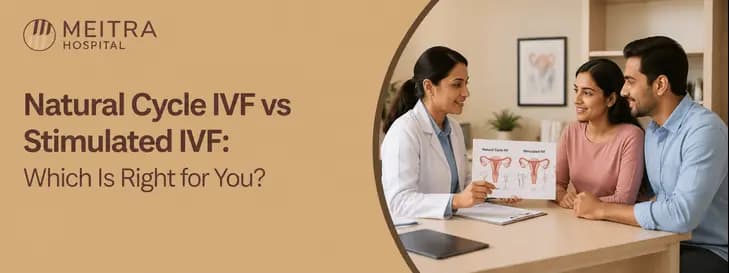

If you've started researching fertility treatment, you've likely run into a fork in the road: Natural Cycle IVF vs Stimulated IVF. One promises a gentler, medication-free process. The other promises higher odds per attempt. Neither claim is wrong, but neither is complete either, and choosing based on which one "sounds" better is exactly how patients end up disappointed with their outcomes.
This article breaks down exactly how the two protocols differ, in mechanism, success rates, cost, and risk, so you can walk into that consultation asking the right questions instead of guessing.
What Is Natural Cycle IVF?
Natural Cycle IVF (NC-IVF) follows your body's own menstrual cycle instead of overriding it. Each month, your ovaries naturally select one dominant follicle destined to release an egg. In a natural cycle, the fertility team monitors this single follicle through ultrasound and bloodwork, times the egg retrieval just before natural ovulation would occur, retrieves that one egg, fertilises it in the lab, and transfers the resulting embryo, all without (or with very minimal) ovarian stimulation medication.
It's important to separate this from Mini IVF, a related but distinct protocol that uses low-dose oral or injectable medication (like clomiphene citrate) to coax two or three eggs rather than just one.
True Natural Cycle IVF uses no stimulation drugs at all, or only a trigger injection to time ovulation precisely. Clinics sometimes use "modified natural cycle" to describe a version that adds a small dose of antagonist medication purely to prevent premature ovulation, not to produce more eggs.
What Is Stimulated (Conventional) IVF?
Stimulated IVF, the protocol most people picture when they hear "IVF" uses injectable gonadotropins (FSH, sometimes combined with LH) over roughly 8-12 days to encourage the ovaries to mature multiple follicles in a single cycle, instead of just the one your body would naturally select. An antagonist or agonist medication is added partway through to prevent premature ovulation, and a trigger injection finalises egg maturation before retrieval.
The purpose of stimulating multiple follicles is straightforward: more eggs mean more chances at fertilisation, more embryos to choose from for transfer, and often, extra embryos available for freezing and future use. This is the protocol most commonly recommended for conditions like PCOS, unexplained infertility, or when genetic testing (PGT-A) of embryos is planned, since it requires multiple embryos to screen from.
Natural Cycle IVF vs Stimulated IVF: Key Differences at a Glance
While both Natural Cycle IVF and Stimulated IVF follow the same core IVF process, they differ in how the ovaries are stimulated, the number of eggs retrieved, treatment intensity, costs, and who is most likely to benefit. The table below highlights the key differences at a glance.
| Factor | Natural Cycle IVF | Stimulated IVF |
|---|---|---|
| Stimulation medication | None or minimal (trigger shot only) | Daily injectable gonadotropins, 8-12 days |
| Eggs retrieved per cycle | Typically 1 (occasionally 0 if ovulation occurs early) | Multiple (often 6-15, varies by ovarian reserve) |
| Monitoring visits | Fewer, but must be precisely timed | Frequent — every 1-3 days during stimulation |
| Embryo freezing option | Rarely, due to only one embryo | Commonly possible with surplus embryos |
| OHSS risk | Negligible | Present, dose-dependent (see risk section below) |
| Physical/emotional burden | Lower | Higher |
| Cost per cycle | Lower | Higher |
| Best suited for | Poor responders, low ovarian reserve, medication-averse patients | PCOS, unexplained infertility, embryo banking, time-sensitive cases |
Side Effects and Health Considerations
Every fertility treatment comes with potential side effects. Understanding them helps you weigh physical and emotional cost.
| Aspect | Natural Cycle IVF | Stimulated IVF |
|---|---|---|
| Hormone load | Minimal to none | High |
| Ovarian hyperstimulation risk | Very low | Moderate to high |
| Bloating and discomfort | Mild | Common |
| Mood changes | Rare | Possible |
| Injection sites | Few or none | Multiple injections |
| Long-term health risks | Not well documented | Extensively studied; generally safe |
Overarian hyperstimulation syndrome (OHSS) is a concern unique to stimulated cycles. In mild cases, you experience bloating, nausea, and pelvic pain. Severe OHSS is rare but serious. Natural cycle IVF carries almost no OHSS risk because you're not manipulating hormone levels.
Emotionally, repeated natural cycles can feel draining due to repeated retrieval procedures and longer timelines. Stimulated cycles are emotionally intense due to daily injections and higher hormonal fluctuations, but they're compressed into fewer overall cycles. The psychological impact of fertility treatment varies greatly by individual and protocol.
Who Should Consider Natural Cycle IVF?
- Women with diminished ovarian reserve (low AMH, low antral follicle count) who respond poorly to stimulation drugs anyway
- Patients who experienced OHSS or severe side effects in a prior stimulated cycle
- Women who prefer to avoid hormonal medication for personal, religious, or health reasons (e.g., a history of hormone-sensitive conditions)
- Patients planning to attempt several low-cost cycles back-to-back rather than one high-cost cycle
- Women in their late 30s to early 40s with regular ovulation who are poor candidates for aggressive stimulation
Who Should Consider Stimulated IVF?
- Women with PCOS, who often produce a high number of follicles and benefit from a controlled, monitored stimulation protocol
- Couples with unexplained infertility, where a larger embryo pool improves the odds of finding a viable one
- Patients who need Preimplantation Genetic Testing (PGT-A), which requires multiple embryos to biopsy and screen
- Couples wanting to freeze extra embryos for a future sibling attempt without repeating the full process
- Time-sensitive cases (e.g., before cancer treatment, or with a ticking biological clock) where maximising the yield from a single cycle matters most


Cost Comparison in India (Per Cycle)
The cost difference between Natural Cycle IVF and Stimulated IVF is driven primarily by fertility medications and the number of treatment cycles required. While Natural Cycle IVF generally has a lower upfront cost per cycle, the overall expense depends on how many cycles are needed to achieve a successful pregnancy. The comparison below outlines the typical cost components.
| Item | Natural Cycle IVF | Stimulated IVF |
|---|---|---|
| Medication cost | Minimal (trigger shot only) | Significant — largest line item in stimulated IVF |
| Monitoring/ultrasound visits | Lower total cost, fewer visits | Higher — frequent monitoring required |
| Lab/embryology charges | Similar per attempt | Similar per attempt, but spread over more embryos |
| Typical per-cycle range in Kerala | Lower end of the local IVF price band | Higher end, largely due to medication |
| Cost if multiple cycles are needed | Can equal or exceed stimulated IVF total cost | Often resolved in fewer cycles |
The practical catch: because natural cycle success rates per attempt are lower, patients frequently need two, three, or more cycles to achieve the same outcome one stimulated cycle might deliver. When you multiply the "cheaper" per-cycle cost by three or four attempts, the total spend and time, can end up comparable to, or higher than, a single well-managed stimulated cycle. This is a conversation worth having with your fertility team using your specific ovarian reserve numbers, not a generic price list.
Risks and Side Effects: OHSS and Beyond
The single biggest risk difference between the two protocols is Ovarian Hyperstimulation Syndrome (OHSS), a complication where the ovaries swell and leak fluid into the abdomen in response to stimulation medication.
Natural Cycle IVF, by definition, avoids this risk almost entirely, since there's no supraphysiological stimulation to trigger it. Beyond OHSS, stimulated IVF also carries a higher likelihood of bloating, mood changes, and injection-site discomfort simply due to the medication load, while natural cycle IVF's main "downside" is emotional: a higher chance that a cycle ends with no viable egg or embryo, requiring another attempt the following month.
How Fertility Specialists Decide Which Protocol Fits You
A responsible fertility work-up looks at several data points together before recommending a protocol, not a single ultrasound scan:
- AMH (Anti-Müllerian Hormone) levels, a marker of ovarian reserve
- Antral Follicle Count (AFC) via ultrasound
- Age and cycle regularity
- Response history, if you've done IVF before
- Underlying diagnosis (PCOS, endometriosis, male factor, unexplained)
- Personal factors, cost tolerance, medication sensitivity, timeline urgency
Two patients with the same age can have very different AMH levels and, therefore, very different recommended protocols. This is why generic online comparisons can only take you so far — the right answer is specific to your ovarian biology.
Natural Cycle IVF vs Stimulated IVF: Which Should You Choose?
If you take one framework away from this article, let it be this: Natural Cycle IVF is not the "gentler default" and Stimulated IVF is not the "guaranteed better outcome." They're two tools designed for different ovarian biology and different priorities.
-
If your ovarian reserve is low and stimulation drugs historically haven't produced much benefit for you, Natural Cycle IVF may reduce cost, medication burden, and OHSS risk without meaningfully sacrificing your odds.
-
If your ovarian reserve is healthy and you're dealing with PCOS, unexplained infertility, or want the option to freeze embryos or run genetic testing, Stimulated IVF's higher per-cycle yield likely serves you better.
-
If you're unsure which category you fall into, that uncertainty itself is the reason to get an AMH/AFC work-up before choosing, not a reason to guess based on which protocol sounds less intimidating.
Why Meitra Hospital Is a Trusted Choice for IVF Decision-Making in Kerala
Choosing between Natural Cycle IVF and Stimulated IVF isn't a decision that should be made from a price list or a brochure, it should follow a proper diagnostic work-up. This is the approach the Obstetrics & Gynaecology department at Meitra Hospital, Kozhikode, is built around: fertility evaluation sits within a full-spectrum women's health department that also handles advanced diagnostics (hysteroscopy, colposcopy, USG, biopsy), hormonal disorders, and gynaecological conditions that often co-exist with infertility, such as fibroids, PCOS, and uterine abnormalities, meaning the same team that investigates why conception hasn't happened is the one guiding how to proceed with IVF.
A few reasons Meitra is a name patients across Kerala, and increasingly, international patients from the Gulf bring up when researching fertility care in the region:
-
Diagnostics-first approach. Rather than defaulting every patient into the same protocol, the evaluation process is built to identify ovarian reserve, hormonal status, and structural factors before a natural or stimulated pathway is recommended.
-
Multidisciplinary backup. Because Meitra is a quaternary-care multispecialty hospital, fertility patients with complicating factors (thyroid disorders, metabolic conditions, prior surgeries) have direct access to endocrinology, radiology, and surgical specialists without being referred out.
-
Accreditation that matters for lab safety. Meitra holds JCI, NABH, NABL, and Green OT accreditation, standards that directly affect embryology lab protocols, infection control, and diagnostic accuracy, which matter enormously in a treatment as lab-dependent as IVF.
-
Transparent, second-opinion friendly culture. Patients are encouraged to bring prior test reports and treatment history for review, rather than being pushed to restart evaluations unnecessarily.
-
Accessible for domestic and international patients. With dedicated support for patients travelling from outside Kozhikode, including other Indian states and Gulf countries, Meitra positions itself as a cost-effective alternative to metro-city or overseas fertility travel, without compromising on accreditation or lab standards.
If you're weighing Natural Cycle IVF against Stimulated IVF and want that decision grounded in your own ovarian reserve numbers rather than general averages, a consultation with Meitra's Obstetrics & Gynaecology team is a reasonable next step, not because one hospital has "the answer," but because this is fundamentally a decision that needs your own diagnostic data, not just an article.
Chat with our medical fertility care assistant for quick answers to your questions, or to book a consultation with the Obstetrics & Gynaecology team and start with a proper ovarian reserve work-up, not a guess.
Medical Disclaimer: This article is intended for general informational and educational purposes only and does not constitute medical advice. IVF protocol suitability depends on individual diagnostic factors, including ovarian reserve, age, and medical history, and must be assessed by a qualified fertility specialist. Please consult a licensed healthcare provider or the Obstetrics & Gynaecology team at Meitra Hospital before making any treatment decisions.