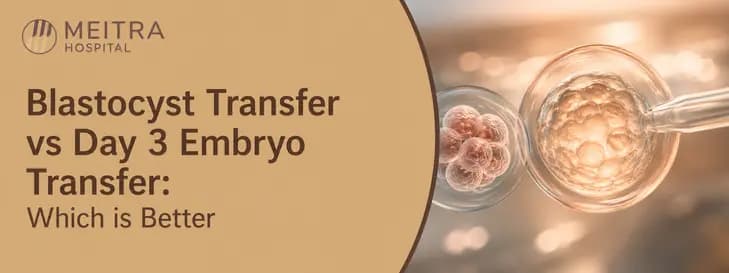

When you decide to pursue IVF treatment, one of the most important decisions is determining when to transfer an embryo into the uterus. Two main options exist: transferring an embryo on day 3 or waiting until day 5 when it reaches the blastocyst stage.
Both approaches have merit, and this guide breaks down what actually happens to an embryo between Day 0 and Day 5, how the two transfer approaches compare on real success-rate data, and, just as importantly, the specific clinical situations where each one is the safer choice.
It's written for anyone starting IVF or ICSI, or currently deciding on transfer timing with their fertility team..
What Is Day 3 (Cleavage-Stage) Embryo Transfer?
Day 3 transfer means placing the embryo into the uterus at the 6–8 cell stage, two days earlier than a blastocyst transfer. It's the older, more established approach and is still the right call in specific situations, most commonly when a patient has only one or two embryos in total.
The logic here is straightforward: if there's a real chance that continuing to culture the embryo in the lab could cause it to arrest before Day 5, even though it might have implanted successfully inside the uterus, waiting is a risk not worth taking when the embryo count is already low. The uterine environment is, after all, the embryo's natural habitat, not a lab dish.
What Is Blastocyst (Day 5) Transfer?
Blastocyst transfer means extending embryo culture in the lab for two additional days before transfer. The clinical rationale isn't that culturing embryos longer makes them "better" it's that extended culture gives embryologists more information to select the best embryo out of several.
When a patient has multiple good-quality Day 3 embryos that all look similar under the microscope, it's genuinely difficult to tell which one has the highest implantation potential. By Day 5, that ambiguity resolves, embryos that were never going to progress typically arrest, and the ones that reach full blastocyst expansion have demonstrably survived a stage that around half of all embryos don't.
This is also why blastocyst transfer is closely tied to elective single embryo transfer (eSET): with better selection information, clinics can transfer one embryo instead of two, reducing twin-pregnancy risk without sacrificing the odds of success.
What Happens Inside the Lab Between Day 0 and Day 5
Every embryo transfer decision starts with the same biological clock. After fertilisation (via IVF or ICSI), the embryo is monitored daily in the lab, and its stage of development on any given day has a name, a cell count, and a grading system attached to it.
-
Day 1–2: The fertilised egg confirms two pronuclei on Day 1, and by Day 2 it has typically divided into 2–4 cells.
-
Day 3 (cleavage stage): The embryo usually reaches 6–8 cells. This is the earliest point at which most clinics can transfer, and embryologists grade it on cell number, symmetry, and fragmentation.
-
Day 5–6 (blastocyst stage): The embryo differentiates into two distinct cell types, the inner cell mass (which becomes the fetus) and the trophectoderm (which becomes the placenta), and expands to 100+ cells. This is graded using the Gardner grading system (expansion stage + inner cell mass grade + trophectoderm grade).
| Development stage | Typical day | Cell count | What's assessed |
|---|---|---|---|
| Zygote | Day 1 | 1 (2 pronuclei) | Fertilisation confirmation |
| Cleavage stage | Day 2–3 | 4–8 cells | Cell number, symmetry, fragmentation |
| Morula | Day 4 | Compacting | Compaction quality |
| Blastocyst | Day 5–6 | 100+ cells | Expansion, inner cell mass, trophectoderm (Gardner grading) |
Also Read: IVF vs Natural Conception: When and Why to Choose IVF
Key Differences and Timeline Comparison
The main difference between day 3 and blastocyst transfer lies in timing and embryo maturity at the moment of transfer. The following table outlines the key distinctions:
| Factor | Day 3 Transfer | Blastocyst Transfer |
|---|---|---|
| Timing | 3 days after fertilisation | 5-6 days after fertilisation |
| Embryo Stage | Cleavage-stage (6-8 cells) | Blastocyst (100+ cells) |
| Cell Organisation | Minimal differentiation | Clear cell specialisation |
| Laboratory Time | Shorter | Longer |
| Selection Pressure | Lower; more embryos survive | Higher; weakest embryos naturally eliminated |
| Uterine Alignment | Earlier than natural implantation window | Matches natural implantation timing |
Day 3 transfer gets embryos into the uterus quickly, which some argue is closer to what happens in natural conception where the embryo may arrive in the uterus between days 3 and 4. Blastocyst transfer, by contrast, gives the embryo more time to demonstrate its potential and gives the uterus more time to prepare for implantation. Both timelines have biological rationale, and the choice often depends on your circumstances and your clinic's expertise.


Blastocyst Transfer vs Day 3 Embryo Transfer: Success Rate Comparison
Success rates can vary by patient and embryo characteristics, but published Indian data provide useful context for how Day 3 and Day 5 transfers have performed in clinical practice.
| Parameter | Day 3 (Cleavage-Stage) | Day 5 (Blastocyst) |
|---|---|---|
| Clinical pregnancy rate | 52.67% | 60.55% |
| Multiple-pregnancy risk | Higher when multiple embryos are transferred | Can be reduced with single-embryo transfer (eSET) |
| Embryos typically needed | May be considered when fewer embryos are available | Extended culture provides an opportunity to select embryos that reach the blastocyst stage |
| Cycle cancellation risk | Generally lower because transfer occurs earlier | Potentially higher because some embryos may not reach Day 5 |
| Best suited for | Selected patients with limited embryo numbers or specific clinical considerations | Patients with suitable numbers of developing embryos where extended culture and blastocyst selection are appropriate |
Why "Which Is Better" Is the Wrong First Question
The comparison numbers above are useful context, but they answer the wrong question if applied uniformly. The right question isn't "which day has better average outcomes" it's "which day suits this embryo cohort." Fertility specialists typically weigh three things:
-
How many embryos are in the cohort. With one or two embryos, most clinics avoid the risk of extended culture and transfer on Day 3.
-
Embryo quality on Day 3. A cohort with several good-quality, high-cell-count embryos is a strong candidate for extending to Day 5, since the extra selection information adds real value.
-
Treatment goals. If PGT-A (genetic testing) is planned, or the patient has had prior failed transfers and wants the most selective approach possible, blastocyst culture is usually preferred, genetic testing itself typically requires the blastocyst stage.
This is also why a rigid "we only transfer on Day 5" policy, or the reverse, is a weaker clinical approach than a lab that reassesses the decision for each patient, each cycle.
Risks and Trade-Offs of Extended Culture to Blastocyst
Extended culture isn't risk-free. The most immediate risk is cycle cancellation, if none of the embryos in a small cohort reach blastocyst stage, there may be nothing left to transfer, whereas a Day 3 transfer would have gone ahead.
Extended culture is also more dependent on lab conditions: incubator stability, culture media quality, and a positive-pressure, filtered lab environment all influence blastocyst formation rates. This is one of the less-discussed reasons embryology lab standards matter as much as the surgeon's or physician's experience in an IVF programme.
Why Meitra Hospital for Blastocyst and Day 3 Embryo Transfer in Kerala
At Meitra Hospital’s Centre for Excellence in Obstetrics & Gynaecology in Kozhikode, the choice between Day 3 and Day 5 embryo transfer is considered on an individual basis rather than following a fixed protocol. The fertility specialist and embryology team assess the embryo development and treatment plan before recommending the most appropriate transfer strategy.
Key factors considered may include:
-
Embryo number and quality: The number and developmental quality of embryos available by Day 3 can influence whether extended culture to the blastocyst stage is appropriate.
-
Ovarian response: The response to stimulation and the number of eggs and embryos obtained are considered when planning transfer.
-
Previous IVF outcomes: Previous treatment history can help the team determine whether a Day 3 or blastocyst transfer may be more appropriate.
-
Genetic testing or freeze-all cycles: When PGT or a planned frozen embryo transfer is involved, the timing and laboratory pathway may differ from a fresh transfer cycle.
Meitra Hospital operates within a JCI-, NABH-, and NABL-accredited hospital infrastructure, with access to multidisciplinary support when fertility treatment involves hormonal, genetic, or reproductive-surgical considerations. Its fertility services also cater to patients from across Kerala and India, as well as international patients.
For patients deciding between Day 3 and Day 5 transfer, the most useful discussion is therefore specific to their own cycle. Ask the fertility team about embryo development, the number of embryos available, expected blastocyst formation, and the clinic’s relevant outcome data rather than assuming that one transfer day is universally better.
Conclusion
Blastocyst (Day 5) transfer and Day 3 (cleavage-stage) transfer aren't competing technologies, they're two tools suited to different embryo cohorts. The data leans toward higher pregnancy rates with blastocyst transfer when there are several good-quality embryos to select from, but that advantage narrows considerably once embryo quality is accounted for, and it disappears as a meaningful choice when only one or two embryos are available.
The decision that matters isn't which approach sounds more advanced, it's which one fits your specific embryo count, quality, and treatment goals, made in consultation with an embryology team that reassesses this for every cycle rather than applying a fixed policy.
Not sure which transfer day is right for your embryos? Chat with Meitra Hospital's medical assistant to get your questions answered, understand what to expect at each stage of your IVF cycle, or book a consultation with the fertility team in Kozhikode.
MEDICAL DISCLAIMER: This article is intended for general informational purposes only and does not constitute medical advice. Embryo transfer timing decisions should always be made in consultation with a qualified fertility specialist and embryologist based on individual diagnostic findings, embryo quality, and treatment history. Success rates cited are drawn from published clinical studies and may not reflect outcomes for every individual or clinic. For personalised guidance, please consult Meitra Hospital's fertility specialists directly.