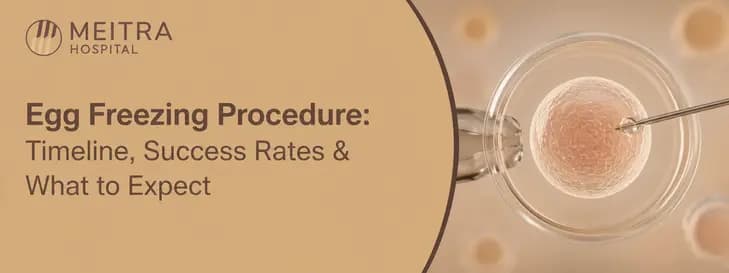

Egg freezing, medically called oocyte cryopreservation, offers women the chance to preserve their fertility for the future. Whether you're focusing on career goals, waiting for the right partner, or facing medical treatments that might affect your fertility, egg freezing provides a proactive option.
Most articles on egg freezing either drown you in cost tables or oversimplify it into "you get an injection, then eggs are frozen." Neither tells you what the procedure actually involves, the daily hormone protocol, the exact retrieval process, what the embryology lab does in the first hour after your eggs are collected, or why your doctor keeps repeating the word "vitrification."
This guide walks through the egg freezing procedure the way a fertility specialist would explain it to you in a consultation room, step by step, with the clinical reasoning behind each stage.
If you're evaluating whether this is the right decision for you, understanding exactly what the procedure entails is the first step.
What is Egg Freezing and Why Choose It
Egg freezing, medically termed oocyte cryopreservation, is a fertility preservation procedure in which a woman's eggs are retrieved from her ovaries, frozen at sub-zero temperatures, and stored for future use.
When she's ready to conceive, the eggs are thawed, fertilised in the lab through ICSI (intracytoplasmic sperm injection), and transferred as an embryo, essentially picking up an IVF cycle from the point it was paused.
Vitrification vs. Slow Freezing
This distinction matters more than most patient-facing content admits. Older slow-freezing techniques cooled eggs gradually, which allowed ice crystals to form inside the cell, damaging the delicate spindle apparatus that holds chromosomes in place.
Vitrification, the method used almost universally today, cools eggs at an ultra-rapid rate (thousands of degrees per minute) using a high concentration of cryoprotectant, turning the cell into a glass-like state without ice crystal formation.
This single lab advancement is largely why egg survival and pregnancy rates improved so significantly over the last decade. If you're evaluating a clinic, ask specifically whether they vitrify, not just whether they "freeze eggs."
What India's ART (Regulation) Act, 2021 Says
Under the ART (Regulation) Act, 2021, frozen eggs in India can legally be stored for up to 10 years, with provisions for extension under specific circumstances. The Act also mandates that only registered, ART-Act-compliant clinics with licensed embryologists can perform and store cryopreservation cycles, a detail worth confirming before you commit to a centre, since not every clinic advertising "egg freezing" is fully compliant.
The Egg Freezing Procedure, Step by Step
Step 1: Fertility Assessment
Before any medication is prescribed, your fertility specialist evaluates your ovarian reserve, essentially, how many eggs you're likely to retrieve in a cycle. This involves:
- An AMH (Anti-Müllerian Hormone) blood test to estimate egg quantity
- A transvaginal ultrasound to count the Antral Follicle Count (AFC)
- Baseline hormone panels (FSH, LH, TSH, prolactin)
- Screening for infectious diseases (HIV, Hepatitis B/C) as mandated under Indian ART regulations
This appointment also sets realistic expectations, a 27-year-old and a 38-year-old walking in with the same intent will often need different stimulation approaches and counselling on expected yield.
Step 2: Ovarian Stimulation (Day-by-Day)
Instead of your body releasing one egg per month, stimulation medication (gonadotropins) is used to encourage the ovaries to mature multiple follicles simultaneously. In practice, this looks like:
| Day | What Happens |
|---|---|
| Day 1–2 (of your cycle) | Baseline ultrasound + bloodwork; stimulation injections begin |
| Day 3–8 | Daily self-administered hormone injections; monitoring visit every 2–3 days |
| Day 8–11 | Follicle growth tracked closely via ultrasound; medication doses adjusted |
| Day 10–12 | Trigger shot administered once follicles reach maturity (~18–20mm) |
| 34–36 hrs post-trigger | Egg retrieval procedure |
The entire stimulation phase typically runs 9–12 days, and yes, it requires daily injections, a detail many patients underestimate going in.
Step 3: Monitoring & the Trigger Shot
Frequent ultrasound and hormone monitoring during stimulation isn't just procedural, it's how your doctor decides the exact day for retrieval and avoids Ovarian Hyperstimulation Syndrome (OHSS), a real risk that a well-monitored protocol substantially reduces. The trigger shot (usually hCG or a GnRH agonist) is timed precisely, it finalises egg maturation roughly 34–36 hours before retrieval.
Step 4: Egg Retrieval
This is a minor surgical procedure done under light sedation or anaesthesia, you won't be conscious or in pain. A thin needle, guided by transvaginal ultrasound, aspirates fluid from each mature follicle, and the eggs are identified under a microscope in real time by the embryology team. The procedure itself takes roughly 15–20 minutes, and most women go home the same day, with mild cramping or spotting for a day or two afterward.
Step 5: Vitrification & Cryostorage
Within an hour of retrieval, embryologists assess which eggs are mature (MII stage) and suitable for freezing, immature eggs typically cannot be vitrified. The mature eggs are then vitrified and stored in secure cryotanks in liquid nitrogen at -196°C, where biological ageing effectively stops.
How Many Eggs Should You Freeze?
Egg count matters more than most patients realise going in, because not every frozen egg survives thawing, fertilises, or develops into a transferable embryo. As a general clinical benchmark:
| Age at Freezing | Recommended Eggs for a Reasonable Live Birth Chance |
|---|---|
| Under 35 | 8–10 mature eggs |
| 35–37 | 12–15 mature eggs |
| 38–40 | 18–20+ mature eggs (may need more than one cycle) |
This is precisely why fertility specialists consistently emphasise freezing earlier rather than later, egg quantity and quality both decline with age, so younger patients often need fewer eggs to reach the same odds of success.
Also Read: Natural Cycle IVF vs Stimulated IVF: Which Is Right for You?


Egg Freezing Success Rates: What the Data Actually Shows
Success-rate marketing on this topic tends to be vague. Here's what peer-reviewed and institutional data actually indicates:
-
Frozen-thawed oocyte survival rates typically range 80–90%, with fertilisation rates of 70–80% after ICSI.
-
Clinical pregnancy rates are estimated at 4–12% per individual thawed oocyte.
-
In real-world outcome data, women who froze their eggs at 35 or younger saw live birth rates of roughly 50% or higher when they later used those eggs, compared to closer to 1 in 5 (≈20%) for women who froze at 40 or older.
Risks and Safety Considerations
Egg freezing is considered a safe, well-established procedure, but it isn't risk-free:
-
OHSS (Ovarian Hyperstimulation Syndrome): Mild forms are relatively common; severe OHSS is rare with proper monitoring.
-
Retrieval-related discomfort: Mild cramping, bloating, or spotting for 1–2 days.
-
Rare procedural risks: Bleeding or infection at the retrieval site (uncommon).
-
No guarantee of pregnancy: Freezing eggs preserves potential, not a guaranteed outcome; this is a critical expectation-setting conversation every reputable clinic should have with you upfront
Egg Freezing Cost in India: What to Realistically Expect
Costs vary by city, clinic infrastructure, medication dosage, and storage duration. Based on current published pricing across major Indian fertility centres:
| Component | Approximate Cost (INR) |
|---|---|
| Initial consultation & fertility workup | INR 5,000 – 15,000 |
| Ovarian stimulation medication | INR 50,000 – 1,00,000 |
| Egg retrieval procedure | INR 30,000 – 50,000 |
| Vitrification & first year of storage | Included in most packages |
| Annual storage (subsequent years) | INR 10,000 – 30,000/year |
| Total for one full cycle | ≈ INR 1,00,000 – 2,50,000 |
(Compiled from published 2025–26 pricing across Indian fertility providers )
Costs can rise with additional stimulation cycles if the first retrieval doesn't yield the recommended egg count for your age group, another reason an accurate initial fertility assessment matters more than the sticker price of a single cycle.
Conclusion
The egg freezing procedure is no longer an experimental or niche option, it's a well-studied, clinically standardised process built around ovarian stimulation, precisely timed egg retrieval, and vitrification. What determines your outcome isn't the marketing around a clinic, but three concrete factors: your age at the time of freezing, the number of mature eggs retrieved, and the quality of the embryology lab handling the vitrification.
Understanding the step-by-step process, and asking the right questions about protocol, lab methodology, and ART Act compliance, puts you in a far stronger position to make this decision on your own timeline, rather than a rushed one.
This is also why the choice of centre matters as much as the choice to freeze at all. At Meitra Hospital's Centre for Excellence in Obstetrics & Gynaecology, egg freezing isn't handled as a standalone add-on, it sits within a broader reproductive medicine framework that includes preconception counselling, infertility evaluation, high-risk pregnancy management, and gynaecological care, all backed by JCI/NABH/NABL-accredited diagnostics and multidisciplinary support on-site.
For a procedure where outcomes hinge on individualised protocol design and lab precision, that continuity, from your first AMH test through to the day you eventually return to use your eggs, is often the difference that patient testimonials don't fully capture but clinical outcomes do.
Contact Meitra Hospital to book a personalised fertility assessment, or chat with our virtual assistant on the Meitra website for quick answers on appointments, doctors, and next steps.
Medical Disclaimer: This article is intended for general informational purposes only and does not constitute medical advice. Egg freezing suitability, protocols, and outcomes vary by individual health history. Please consult a qualified fertility specialist at Meitra Hospital or another accredited clinic for a personalised evaluation before making any treatment decisions.