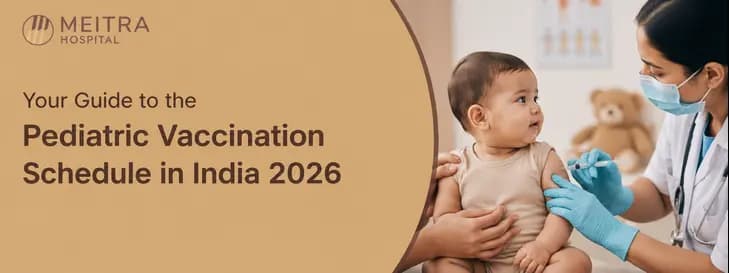

Your child's vaccination schedule is a roadmap that protects them from serious, preventable diseases during their most vulnerable years. In India, the immunisation timeline starts at birth and continues through adolescence, following guidelines set by the Indian Academy of Pediatrics (IAP) and the Government's Universal Immunisation Programme (UIP).
This guide lays out the complete, age-wise pediatric vaccination schedule for Indian children, based on the Indian Academy of Pediatrics (IAP) Advisory Committee on Vaccines and Immunization Practices (ACVIP) 2025 recommendations, along with what changed this year, how to read the difference between the free government schedule and the private one, what to do if you've missed a dose, and how to know when a reaction needs a doctor's attention rather than a wait-and-watch approach.
What is a pediatric vaccination schedule and why it matters
A pediatric vaccination schedule is a plan that tells you which vaccines your child should receive and when. Your child's immune system is still developing, so vaccines given at the right ages work best to protect them. The schedule is carefully designed based on when children are most vulnerable to certain diseases and when their bodies respond best to vaccines.
Vaccinations are one of the most effective ways to prevent childhood diseases like measles, polio, whooping cough, and meningitis. When you vaccinate your child on time, you protect not only them but also vulnerable babies and elderly people in your community who cannot receive vaccines. According to the World Health Organization, vaccines prevent 4-5 million deaths every year globally.
The pediatric vaccination schedule in India combines vaccines recommended by the government (UIP schedule) with additional vaccines suggested by the Indian Academy of Pediatrics. Your pediatrician can help you choose the right approach for your child's health needs.
IAP vs UIP: India's Two Vaccination Schedules, Explained
Almost every parent hits this fork early: should you follow the government schedule or the "private" one your pediatrician recommends? Both are legitimate, they're just built for different scopes.
The Universal Immunization Programme (UIP) is the Government of India's free schedule, available at any government hospital, primary health centre, or Anganwadi. It covers the vaccines with the largest public-health burden: BCG, OPV, Hepatitis B, the pentavalent vaccine (DTwP, Hepatitis B, Hib), Rotavirus, fractional IPV, PCV, MR/MMR, and, as of a February 2026 update, a free HPV dose for 14-year-old girls.
The IAP schedule, maintained by the Indian Academy of Pediatrics' ACVIP and revised annually, is broader. It includes everything in the UIP plus vaccines against diseases the UIP doesn't yet cover for all age groups, Hepatitis A, Varicella (chickenpox), Typhoid, Influenza, and an expanded HPV recommendation.
| UIP (Government, free) | IAP (Private, recommended) | |
|---|---|---|
| Cost | Free | Paid |
| Diseases covered | ~12 core diseases | 20+ diseases |
| Update frequency | Less frequent | Reviewed annually |
| Where administered | Govt. hospitals, PHCs, Anganwadi centres | Private pediatric clinics/hospitals |
| Extra protection | — | Rotavirus (in some states), PCV, Hep A, Varicella, Typhoid, Influenza, HPV |
If cost is a genuine constraint, the UIP alone still protects against the diseases responsible for the most child deaths and disability, don't skip it.
If you can add the IAP vaccines, most pediatricians recommend doing so, since urban and semi-urban children face measurably higher exposure risk to diseases like rotavirus diarrhoea and pneumococcal pneumonia.
Core vaccines every child needs: what they protect against
Core vaccines are those recommended for all children because the diseases they prevent are serious and can spread easily. Understanding what each vaccine protects against helps you see why they matter. The following table shows the main core vaccines your child will receive:
| Vaccine | Protects Against | Ages Given |
|---|---|---|
| BCG | Tuberculosis, a lung infection | Birth |
| Polio | Polio, a virus affecting nerves | Birth, 6 weeks, 10 weeks, 14 weeks, and boosters |
| Hepatitis B | Liver infection | Birth, 6 weeks, 10 weeks, 14 weeks |
| Rotavirus | Severe diarrhoea in babies | 6 weeks, 10 weeks, 14 weeks |
| Pentavalent | Diphtheria, whooping cough, tetanus, hepatitis B, and Haemophilus influenzae type b | 6 weeks, 10 weeks, 14 weeks, booster at 18 months |
| Pneumococcal | Pneumonia, ear infections, meningitis | 6 weeks, 10 weeks, 14 weeks, booster at 12-15 months |
| Measles/MMR | Measles, mumps, rubella | 9 months, booster at 15-18 months |
| Japanese Encephalitis | Japanese encephalitis (in endemic areas) | Timing varies by region |
Each vaccine trains your child's immune system to recognize and fight specific diseases without causing the illness itself.
Complete Age-Wise Pediatric Vaccination Schedule (IAP 2025–26)
This table reflects the IAP ACVIP's Recommended Immunization Schedule finalized November 2025, published in Indian Pediatrics.
| Age | Vaccines Due |
|---|---|
| At birth | BCG, OPV-0, Hepatitis B-1 |
| 6 weeks | DTwP/DTaP-1, IPV-1, Hib-1, Hepatitis B-2, Rotavirus-1, PCV-1 |
| 10 weeks | DTwP/DTaP-2, IPV-2, Hib-2, Rotavirus-2, PCV-2 |
| 14 weeks | DTwP/DTaP-3, IPV-3, Hib-3, Hepatitis B-3, Rotavirus-3, PCV-3 |
| 6 months | Influenza-1 (annual, now trivalent), OPV booster (in UIP areas) |
| 7 months | Influenza-2 (if starting series after 6 months) |
| 9 months | MMR-1 (Measles-Mumps-Rubella), Typhoid Conjugate Vaccine |
| 12 months | Hepatitis A-1 |
| 12–15 months | PCV booster |
| 15–18 months | DTwP/DTaP booster-1, IPV booster-1, Hib booster, MMR-2, Varicella-1 |
| 18–19 months | Hepatitis A-2 |
| 2 years | Typhoid booster (every 3 years thereafter) |
| 4–6 years | DTwP/DTaP booster-2, IPV booster-2, MMR-3 (if not given), Varicella-2 |
| 9–15 years (girls) | HPV — 1 dose (single-dose schedule now acceptable per 2025 update) |
| 10–12 years | Tdap/Td booster |
| Annual, all ages 6 months+ | Influenza (trivalent, updated yearly) |
What Changed in the IAP 2025–26 Advisory
A few updates from this year's ACVIP revision are worth knowing firsthand, since most existing online charts haven't caught up yet:
-
Trivalent flu vaccine replaces quadrivalent. The B/Yamagata influenza lineage hasn't been detected in years and is now considered functionally extinct, so this season's vaccines dropped it, meaning your child's flu shot covers three strains (A/H1N1, A/H3N2, B/Victoria) instead of four.
-
Nirsevimab for RSV is now a recommended option (after discussing with your pediatrician) for high-risk infants, this is a monoclonal antibody, not a traditional vaccine, but it's included in the same immunization advisory for RSV prevention.
-
HPV vaccination simplified: immunocompetent girls aged 9–15 can now receive a single dose instead of the earlier two-dose series, lowering the barrier to completion.
-
Rabies post-exposure protocol is now standardized to a 5-dose intramuscular schedule (days 0, 3, 7, 14, 28) alongside immunoglobulin for bite cases, relevant given how common stray-animal exposure is for children in Indian cities.


Common Vaccine Reactions and When They Need Medical Attention
Most vaccine reactions are mild and temporary, but some symptoms may require prompt medical attention. Use the guide below to know what is expected and when to seek help.
| Normal, expected reactions | See a doctor if you notice |
|---|---|
| Mild fever (under 102°F) for 1–2 days | Fever above 104°F, or fever lasting more than 2 days |
| Soreness, redness, or a small lump at the injection site | Swelling that spreads beyond the injection site, or pus |
| Fussiness or reduced appetite for a day | Persistent inconsolable crying for 3+ hours |
| Mild rash after MMR/Varicella (7–12 days later) | Difficulty breathing, facial swelling, or hives (possible allergic reaction) |
| Drowsiness | Seizures, unusual limpness, or unresponsiveness |
Severe allergic reactions to vaccines are rare, but they can occur within minutes to hours, which is why pediatric clinics typically ask you to wait 15–30 minutes on-site after a shot before heading home.
Catch-Up Vaccination: What to Do If a Dose Was Missed or Delayed
A missed dose does not mean starting the entire series over, this is one of the most common (and unnecessary) sources of parental anxiety. The IAP catch-up principle is straightforward: pick up from the next due dose, maintaining minimum spacing intervals between doses, rather than repeating what's already been given.
What does change is the timeline, your pediatrician will recalculate intervals based on the child's current age and prior dose history, which is exactly the kind of individualized decision that's hard to get right from a generic online chart. If your child has fallen behind by more than a few weeks on any vaccine, book a catch-up consultation rather than trying to self-calculate the new schedule.
How to Choose the Right Pediatrician to Manage Your Child's Vaccination Schedule
A few practical filters, wherever you're located in India:
-
Maintains a documented immunization record (physical card plus digital backup) and proactively reminds you of upcoming due dates.
-
Follows the current-year IAP schedule, not an outdated version, ask when their protocol was last updated.
-
Has NICU/emergency backup on-site or nearby, in case of a rare adverse reaction.
-
Explains combination vaccines and brand choices (e.g., hexavalent vs pentavalent) rather than defaulting to one option without discussion.
-
Offers same-day or next-day appointments for catch-up doses, delays here compound.
Why Families Choose Meitra Hospital for Pediatric Vaccination and Care
Meitra Hospital offers pediatric vaccination as part of comprehensive well-child care, rather than as a stand-alone service.
-
Integrated care: Vaccination visits can include growth and developmental monitoring, helping identify missed milestones or catch-up vaccination needs.
-
Specialized pediatric support: Dedicated NICU and PICU facilities support premature babies and children requiring advanced medical care.
-
Continuity of care: Children with medical conditions or modified vaccination needs can receive guidance from the pediatric team managing their broader care.
-
Accredited standards: Meitra is NABH accredited and has Green OT facilities.
-
International patient support: Dedicated services can help NRI and Gulf-based families maintain continuity of pediatric records and vaccination schedules during visits to Kerala.
Whether your child needs routine immunization, a catch-up vaccination, or a developmental check-up, Meitra’s Pediatrics Department can provide age-appropriate guidance and care.
Conclusion
The pediatric vaccination schedule can look intimidating on paper, two overlapping charts, annual revisions, age windows measured in weeks. But the underlying logic is simple: timing matters more than most parents realize, missed doses are recoverable without restarting anything, and the biggest real-world risk isn't the schedule itself but the tracking gap between what's supposed to happen and what actually gets documented.
Keep a record, ask your pediatrician when their protocol was last updated, and treat every well-child visit as a chance to close any gaps, that's the single habit that does more for your child's protection than any chart alone.
Chat with our Care Assistant for guidance, or to book a well-child visit with Meitra Hospital's Pediatrics team in Kozhikode.
Medical Disclaimer: This article is intended for general informational purposes only and does not constitute medical advice. Vaccination schedules can vary based on a child's individual health status, medical history, and regional guidelines. Please consult a qualified pediatrician before starting, modifying, or catching up on any vaccination schedule for your child.