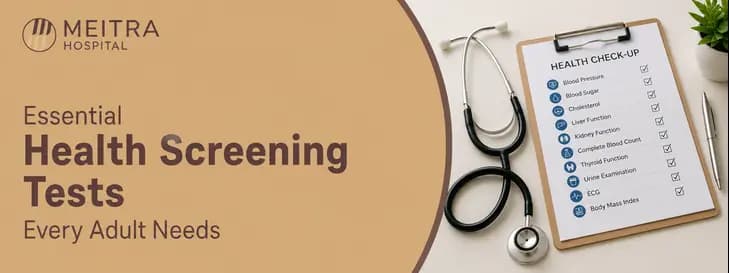

Most adults skip routine health screenings until something feels wrong. Yet catching disease early, when treatment works best, depends on tests you may not even know you need.
This guide breaks down exactly which tests matter, at what age, for men and for women, why generic "checkup packages" often waste your money on tests you don't need, and what a genuinely tailored screening plan looks like, including how hospitals in Kerala, such as Meitra Hospital in Kozhikode, structure preventive care around risk profiles rather than a fixed template.
Why Adult Health Screening Matters
Health screening is not about diagnosis or treatment of disease you already have. Instead, screening aims to find hidden disease before you feel any symptoms. Many serious conditions, high blood pressure, diabetes, heart disease, and several cancers, develop silently for years before causing pain or discomfort. By the time you notice symptoms, the disease may already be advanced and harder to treat. Regular screening catches these conditions early, when lifestyle changes or early medicine often work best. Research shows that preventive screening dramatically improves survival rates for conditions like colon cancer, breast cancer, and cardiovascular disease.
In India, where many adults live with undiagnosed diabetes and high blood pressure, routine screening remains underused despite being one of the most cost-effective health investments you can make. Starting screening in your 20s or 30s establishes a baseline for your health and helps your doctor spot changes over time. Even if you feel perfectly healthy today, screening gives you and your doctor the information needed to keep you that way.
The Essential Health Screening Tests Every Adult Needs
Here is the core panel most general physicians and internal medicine specialists recommend as a baseline for adults, regardless of which "package" name a hospital sells it under.
1. Blood Pressure Screening
A two-minute cuff reading, recommended at least once every two years from age 18, and annually if your first reading is elevated or you have a family history of heart disease. It's the single cheapest, fastest test on this list, and arguably the most consequential, since sustained high blood pressure is a leading driver of stroke, heart attack, and kidney disease.
2. Blood Sugar & HbA1c (Diabetes Screening)
A fasting blood glucose test, and ideally an HbA1c (which reflects your average blood sugar over the past 2–3 months rather than a single day), should be part of every adult's annual panel, especially past age 30, or earlier with a family history of diabetes, obesity, or a sedentary lifestyle. India has one of the largest diabetic populations in the world, and a meaningful share of cases remain undiagnosed simply because no one tested.
3. Lipid Profile (Cholesterol)
This blood test measures LDL ("bad" cholesterol), HDL ("good" cholesterol), and triglycerides. Cardiology guidelines increasingly recommend a baseline lipid profile as early as age 20, repeated every 4–6 years for low-risk adults, and more frequently for anyone with diabetes, obesity, or a family history of cardiovascular disease.
4. Complete Blood Count (CBC)
A CBC evaluates red blood cells, white blood cells, hemoglobin, and platelets in a single blood draw. It's often the first test that flags anemia, infection, inflammation, or early signs of a blood disorder, even in someone who feels completely fine.
5. Liver Function Test (LFT)
LFTs assess enzymes like ALT, AST, and bilirubin. With non-alcoholic fatty liver disease (NAFLD) rising sharply alongside obesity and diabetes rates, an annual LFT is now considered part of a standard adult panel rather than a specialist-only test.
6. Kidney Function Test (KFT/RFT)
Measures creatinine, blood urea nitrogen (BUN), and electrolytes to assess how efficiently your kidneys are filtering waste. This matters even more for adults with diabetes or hypertension, since both conditions are leading causes of chronic kidney disease.
7. Thyroid Function Test (TSH)
A simple TSH blood test can catch an underactive or overactive thyroid, conditions that often masquerade as fatigue, weight changes, or mood shifts, and are frequently missed for years because the symptoms get attributed to "stress" or "lifestyle."
8. Cancer Screenings
Recommendations vary by age, sex, and family history, but the core list includes:
- Breast cancer: clinical breast exam and mammography, typically starting age 40–45, or earlier with family history
- Cervical cancer: Pap smear/HPV test from age 21–25, every 3–5 years
- Colorectal cancer: colonoscopy from age 45 for average-risk adults
- Oral cancer: annual screening, especially relevant given India's tobacco and areca nut use patterns
- Prostate cancer: PSA blood test discussion with a doctor from age 50, or 45 with family history
9. Bone Density Test (DEXA)
Recommended for women from age 65 (or earlier post-menopause with risk factors) and for men from age 70, or earlier with risk factors like long-term steroid use or a family history of osteoporosis.
10. Eye, Dental & Mental Health Screening
Often skipped in a "medical" checkup, but genuinely essential: an annual eye exam catches glaucoma and diabetic retinopathy early; dental checkups catch decay and gum disease before they become costly; and a basic mental health screening, especially for adults managing chronic stress or a chronic physical condition, is now considered a standard part of comprehensive preventive care by most primary care guidelines.


Health Screening Schedule by Age
The right screening schedule depends on age, personal risk factors, family history, and previous results. The following age-wise framework provides a starting point for discussing which checks may be appropriate with your doctor.
| Age Group | Priority Tests |
|---|---|
| 20s | Blood pressure, baseline lipid profile, BMI/weight tracking, Pap smear (women), dental & eye checkup |
| 30s | Fasting blood sugar/HbA1c, thyroid panel, CBC, LFT, KFT |
| 40s | Mammography (women), colonoscopy baseline (from 45), PSA discussion (men, from 45–50 with risk factors), ECG |
| 50+ | DEXA scan, more frequent cardiac screening, repeat colonoscopy per prior findings, comprehensive cancer panel based on risk profile |
Do Screening Needs Differ for Men and Women?
Broadly, yes while the core metabolic panel (BP, sugar, lipids, CBC, LFT, KFT, thyroid) applies to everyone, sex-specific risk drives the rest of the list.
| Men | Women | |
|---|---|---|
| Cancer focus | Prostate, colorectal, oral | Breast, cervical, ovarian, colorectal |
| Heart risk timeline | Often assessed earlier (30s–40s) | Risk rises notably post-menopause |
| Additional tests | PSA (from 45–50) | Pap smear/HPV, mammography, bone density post-menopause |
Why "One-Size-Fits-All" Health Checkup Packages Don't Work
Here's something most hospital marketing pages won't tell you directly: a rigid, pre-fixed package, the "General," "Executive," or "Gold/Platinum" bundles many diagnostic chains sell, is often not the most useful way to screen.
If you're a 35-year-old with no cardiac risk factors and a healthy lifestyle, an ECG, stress test, and echo bundled into a "premium" package may add cost without adding meaningful clinical value, while a genuinely relevant test for your risk profile, say, a targeted cancer marker, might not be included at all.
The more useful approach, is to let age, sex, family history, and lifestyle risk factors decide which tests you actually need and to redirect the money saved on unnecessary tests toward ones that are genuinely relevant to you.
This is also why a consultation-led approach (a physician reviewing your history before recommending a panel) tends to catch more than a fixed checklist ever will. Medical science still has plenty of blind spots, and no package, however comprehensive can substitute for a doctor connecting your specific risk factors to the right tests.
Choosing the Right Preventive Health Package in Kozhikode: What Meitra Hospital Offers
If you're in Kozhikode or the wider Malabar region and looking for where to get preventive health tests done, Meitra Hospital offers health screening programmes organised around different life stages and risk profiles rather than a single generic package. Its preventive health programme includes options designed for specific age groups, health concerns, and screening needs.
Some of the available preventive health packages include:
- Basic Preventive Health Care: A general health assessment for routine preventive screening.
- Adolescent Care: Designed around the health needs of adolescents.
- Women's Health Care and Women's Heart Care: Focused screening options addressing women's general and cardiovascular health.
- Men's Health Care – Premium: A more comprehensive preventive assessment for men.
- Elderly Care: Dedicated packages for men and women aged 60 and above.
- Diabetic Care and Diabetic-Heart Care: Screening focused on diabetes and associated cardiovascular risks.
- Cancer Screening: Dedicated screening panels for both men and women.
- Brain Care: A preventive assessment focused on neurological health.
- Veiia Life Care: An advanced programme that includes the Veiia Life Index Score and epigenetic screening for a deeper, biomarker-based assessment.
The diagnostic infrastructure supporting these programmes is also important. Meitra Hospital is a NABH-accredited tertiary care hospital with an NABL-accredited laboratory operating under ILAC MRA standards. Its Centres of Excellence cover areas including:
- Heart & Vascular Care
- Nephro-Urosciences
- Gastrosciences
- Neurosciences
- Blood Diseases & Cancer Immunotherapy
This means an abnormal screening result can be followed by specialist evaluation and further care within the same institution when required, rather than necessarily requiring a separate referral.
For patients travelling from outside Kerala, including NRIs and international visitors, Meitra also provides an international patient programme. The practical advantage is that screening, specialist consultation, and further treatment planning can be coordinated during the same visit.
Ultimately, the right package should be selected according to age, sex, existing conditions, family history, lifestyle, and individual risk factors rather than simply choosing the most comprehensive package available.
What Happens After Your Screening? Reading and Acting on Your Report
A screening test only creates value if someone acts on the result. In practice, that means three things: first, get your results explained by a physician rather than self-interpreting reference ranges (a "borderline" value on paper often needs clinical context to know if it's significant).
Second, if a result is abnormal, book the follow-up consultation immediately rather than waiting for your next annual checkup, early-stage findings are, by definition, time-sensitive.
Third, keep a running record of your results year over year; a single reading tells you where you stand today, but a trend line, rising fasting glucose over three years, for instance,often tells a more useful story than any single test result in isolation.
Conclusion
Health screening isn't about running every test available, it's about running the right tests, at the right age, based on your actual risk profile, and consistently enough that a trend can emerge before a disease does.
The core panel, blood pressure, blood sugar, lipid profile, CBC, liver and kidney function, thyroid, and age-appropriate cancer screening, covers the vast majority of what silently drives illness in adults today.
Where you get it done matters almost as much as what you get done: accredited labs, a physician-led review of your results, and access to the right specialist if something needs a closer look, is what turns a checkup from a formality into genuine preventive care.
If you're due for a screening and unsure where to start, a short conversation with a physician about your family history and lifestyle is the most useful first step you can take.
Chat with Meitra's care assistant today to find the preventive health package that fits your age, gender, and health history, or book a consultation directly with a Meitra physician.
Medical Disclaimer: This article is intended for general informational purposes only and does not constitute medical advice, diagnosis, or treatment. Screening recommendations vary based on individual health history, risk factors, and clinical judgment. Please consult a qualified physician before starting, changing, or stopping any health screening plan.