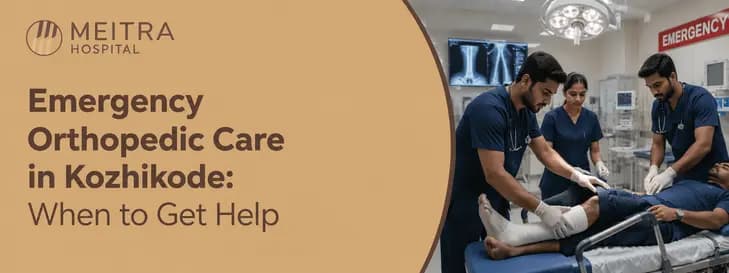

When a sudden bone or joint injury strikes, every minute counts. In Kozhikode, immediate access to skilled orthopedic care can mean the difference between quick recovery and long-term complications.
This guide is written for exactly that moment: when you or someone with you has a bone, joint, or spine injury and you need to know, quickly and clearly, what qualifies as an emergency, what to do in the first few minutes, and what proper emergency orthopedic care in Kozhikode actually looks like once you reach a hospital.
What Counts as an Orthopedic Emergency?
Not every ache or sprain needs an ER visit. Orthopedic emergencies are injuries where delay measurably worsens the outcome, through blood loss, nerve damage, infection risk, or loss of blood supply to a limb.
Needs immediate emergency care:
- Open (compound) fractures, where bone has pierced the skin
- Any fracture with visible deformity, especially in the thigh, hip, or upper arm
- Joint dislocations (shoulder, hip, knee, elbow, ankle)
- Suspected spinal injury after a fall or accident, especially with numbness, tingling, or loss of movement
- Pelvic fractures from high-impact accidents
- Crush injuries or injuries with heavy bleeding
- A limb that looks pale, cold, or has no pulse below the injury site (a sign of blocked blood supply)
- Inability to bear any weight combined with severe, worsening pain
Can usually wait for a same-day or next-day OPD consultation:
- Mild sprains with swelling but the joint is still stable
- Old, low-grade joint pain that has flared up
- Minor bruising without deformity or loss of function
If there's genuine doubt, orthopedic specialists consistently advise erring on the side of getting evaluated sooner, a same-day ortho consult costs far less than a fracture that has shifted or a nerve that has been compressed for too long.
The "Golden Hour" in Orthopedic Trauma: Why Timing Decides Outcomes
In trauma medicine, the "golden hour" refers to the first 60 minutes after a serious injury, when prompt, definitive treatment has the strongest effect on preventing death or permanent disability.
For orthopedic trauma specifically, this window matters for a very concrete reason: a displaced fracture or dislocation can compress nearby blood vessels and nerves, and the longer that compression continues, the higher the risk of permanent nerve damage or tissue death that no surgery can later reverse.
According to an analysis published by the Oxford Human Rights Hub, only about 20% of accident victims in India currently reach medical care within the golden hour, and ambulance coverage in much of the country remains well below WHO-recommended levels.
The takeaway for anyone in Kozhikode is practical: knowing in advance which hospital has a 24x7 orthopedic emergency team, rather than deciding mid-crisis, can meaningfully shrink that window.
First Aid Before You Reach the Hospital: Do's and Don'ts
What happens in the first few minutes, before any ambulance or hospital is involved genuinely changes outcomes. Here's a quick-reference table.
| Situation | Do's | Don'ts |
|---|---|---|
| Suspected fracture | Immobilize the limb in the position found, using a splint, board, or rolled newspaper/cloth if nothing else is available | Don't try to straighten a deformed limb or "push" bone back into place |
| Open/compound fracture | Cover the wound with a clean cloth to control bleeding and reduce infection risk | Don't try to push protruding bone back under the skin |
| Suspected dislocation | Support the joint in the position it's in; apply a cold pack if available | Don't attempt to "pop" the joint back yourself |
| Suspected spinal injury | Keep the person still; call for help; avoid moving the head, neck, or back | Don't sit the person up or move them unless there's an immediate danger (like fire) |
| Any orthopedic injury | Note the time of injury and how it happened, this speeds up ER assessment | Don't give food or water if surgery may be needed soon after |


What Happens Inside a Hospital Emergency Room for Ortho Cases
Once you arrive at the emergency room, the orthopedic team follows a structured process to assess your condition, stabilize your injury, and begin the right treatment as quickly as possible.
1. Triage and primary survey.
On arrival, emergency staff first check airway, breathing, circulation, and level of consciousness, standard for any trauma case, before focusing on the injured limb or joint. This sequence exists because orthopedic injuries, however dramatic they look, are rarely the most immediately life-threatening issue in a polytrauma patient; internal bleeding or airway compromise take priority.
2. Imaging.
X-rays remain the first-line tool for confirming a fracture or dislocation. CT scans are added for complex fractures (pelvis, spine, joints with multiple fracture lines) where a 2D X-ray doesn't show the full picture. MRI is used selectively, mainly for suspected ligament, tendon, or spinal cord involvement, since it takes longer and isn't always needed in the acute setting.
3. Orthopedic surgeon involvement.
For anything beyond a simple, non-displaced fracture, the ER doctor loops in an on-call orthopedic surgeon, who decides between immediate closed reduction (manually realigning the bone without surgery, usually under sedation) versus taking the patient to the operating theatre.
Recovery and Follow-up Care
Recovery from acute orthopedic injuries is a progressive journey. Immediately after treatment, whether conservative or surgical, the focus is controlling swelling, protecting the healing area, and starting gentle movements as soon as safe. Physical therapy begins early, guided by your specialist's restrictions. Therapists design exercises that restore strength, flexibility, and confidence in the injured limb without risking re-injury.
Treatment Pathways for Orthopedic Emergencies
The right treatment depends on the type, severity, and location of the injury. While many orthopedic emergencies can be managed without surgery, others require immediate surgical intervention.
Non-surgical management covers a large share of emergency ortho cases:
- Closed reduction: realigning a displaced fracture or dislocated joint without an incision, usually under local or general anesthesia
- Casting and splinting: stabilizing the bone once it's aligned, to allow natural healing
- Traction: applying controlled pulling force, mainly for certain hip and thigh fractures, to reduce muscle spasm before definitive treatment.
Surgical management is needed when the fracture is unstable, displaced, involves a joint surface, or has damaged surrounding structures:
- ORIF (Open Reduction and Internal Fixation): plates, screws, or rods are used to hold bone fragments together internally
- External fixation: a frame is attached outside the body when internal fixation isn't immediately safe, often in cases with significant soft-tissue damage or contamination
- Intramedullary nailing: a rod inserted through the core of long bones like the femur or tibia, common for high-impact fractures
- Robotic-assisted trauma reconstruction: increasingly used for complex joint fractures where precise alignment materially affects long-term joint function.
Special situations deserve their own mention. Pediatric fractures often heal faster but need careful handling around growth plates. Elderly hip fractures are treated as time-sensitive surgical emergencies in most modern protocols, since prolonged bed rest in older patients carries its own serious risks.
Polytrauma cases, where orthopedic injury is one of several, need a hospital where orthopedics, general surgery, neurosurgery, and critical care can coordinate under one roof, rather than referring the patient elsewhere mid-crisis.
Why Meitra Hospital Is Built for Orthopedic Emergencies in Kozhikode
Emergency orthopedic outcomes depend less on any single doctor and more on the surrounding system: how fast imaging comes back, whether an ICU bed is available if the injury is part of a larger polytrauma, and whether the surgical team has handled complex trauma reconstructions before. This is where Meitra Hospital's Department of Orthopaedics, part of its Centre of Excellence in Bone, Joint and Spine Care, is structured specifically around that need.
A few things stand out for trauma and emergency cases specifically:
-
Integrated Ortho-Neuro-Spine setup. Meitra runs one of the few integrated Ortho-Neuro-Spine centres in the region, built around an intraoperative 'O-arm' imaging system, relevant for pelvic, spinal, and complex joint fractures where surgeons need real-time 3D imaging during the procedure itself, rather than relying only on pre-op scans.
-
Robotic-assisted precision for joint trauma. The hospital uses the CORI robotic surgical platform, originally built for joint replacement, which is also applied in select complex trauma-related joint reconstructions to improve alignment accuracy.
-
24x7 emergency backbone. A round-the-clock emergency department backed by in-house radiology, a blood bank, and 52 individual ICU beds means a polytrauma patient doesn't need to be stabilized and then transferred elsewhere for the next level of care.
-
Accreditation that reflects process, not just equipment. Meitra is accredited by NABH and NABL, and holds Green OT certification, and is recognized as the first hospital in the Malabar region to receive Joint Commission International (JCI) accreditation, a standard that specifically audits emergency response protocols and patient safety systems, not just clinical outcomes.
-
Built for both local and long-distance patients. Because a meaningful share of Meitra's patients travel from across Kerala, other states, and abroad (including a dedicated floor and coordination desk for international patients), the hospital's billing and admission process is set up to move quickly even for someone arriving without prior paperwork, which matters most in an emergency.
None of this replaces the judgment of the treating doctor at the time of injury. But for anyone in Kozhikode mapping out "which hospital do I go to if something happens," it's a relevant data point that a trauma-ready orthopedic setup, multi-specialty backup, and international-standard accreditation exist within the district itself.
What Does Emergency Orthopedic Treatment Cost in Kozhikode?
Costs for emergency orthopedic care vary widely because the injury itself varies widely, a hairline fracture treated with a cast costs a fraction of a complex pelvic fracture needing multiple surgical fixations and an ICU stay. Broadly, the bill is shaped by:
- Type and number of imaging studies (X-ray vs. CT vs. MRI)
- Whether the treatment is closed reduction/casting or surgical fixation
- Implant type (plates, screws, rods, external fixators)
- Operating theatre time and anesthesia
- Length of hospital and ICU stay
- Physiotherapy and follow-up visits
Most accredited hospitals in Kozhikode, including Meitra hospital, accept cashless treatment through empanelled insurers and offer transparent cost estimates before elective portions of treatment, though true emergencies are, appropriately, treated first and billed afterward.
Conclusion
Orthopedic emergencies are decided in minutes, not hours, by how quickly a displaced fracture is stabilized, how fast imaging confirms what's actually broken, and whether the hospital you reach has the surgical and critical-care backup to handle complications if the injury turns out to be more serious than it first looked.
Knowing the difference between an injury that can wait and one that can't, doing the right first aid in the first few minutes, and having a trauma-ready hospital already in mind are the three things that most reliably improve outcomes, long before any doctor gets involved.
If you or a family member is dealing with a fracture, dislocation, or accident injury right now, don't wait to figure out next steps alone. Chat with our assistant for immediate guidance on symptoms and nearest care.
Medical Disclaimer: This article is for general informational purposes only and does not constitute medical advice, diagnosis, or treatment. Always consult a qualified orthopedic surgeon or emergency physician for any injury. In case of a medical emergency, contact your nearest hospital or emergency services immediately.