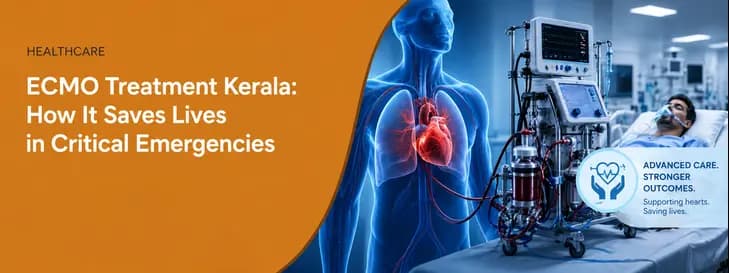

There is a particular kind of emergency every ICU team dreads: a patient whose heart or lungs are failing so severely that a ventilator and medication are no longer enough. Blood oxygen keeps dropping. Blood pressure keeps slipping. In moments like this, doctors have one more option before the situation becomes unrecoverable, Extracorporeal Membrane Oxygenation, or ECMO.
ECMO is not a new invention, but its role in Indian critical care, and in Kerala specifically, has grown considerably over the last decade. Severe respiratory infections, post-COVID lung complications, sudden cardiac events, and complex post-surgical recoveries have all pushed ECMO from a niche, rarely-used therapy into a frontline tool in advanced ICUs.
According to registry-based clinical literature tracking adult ECMO outcomes, more than half of patients placed on ECMO for severe respiratory failure survive to hospital discharge, with reported survival rates around 55–58 percent. That is a meaningful number, it means a therapy once seen as a last resort is, for many patients, genuinely life-saving.
This article explains what ECMO actually is, how it works, when doctors recommend it, what the real risks and survival data look like, and what to consider when evaluating ECMO-capable hospitals in Kerala. We'll also take a closer look at how Meitra Hospital in Kozhikode has built a dedicated critical care and ECMO programme, not as a sales pitch, but as a useful reference point for what a serious ECMO setup looks like.
What is ECMO Treatment and How Does It Work?
ECMO stands for Extracorporeal Membrane Oxygenation. Broken down, "extracorporeal" simply means "outside the body" and that's exactly what happens. A patient's blood is withdrawn through a tube, passed through a machine that adds oxygen and removes carbon dioxide, and then pumped back into the body. In effect, the machine is doing the work the heart and lungs can no longer manage on their own.
It's worth being clear about something many patients and families misunderstand: ECMO is not a cure. It doesn't repair a damaged heart valve or heal infected lung tissue. What it does is buy time; time for the heart and lungs to rest and recover, time for medications to work, or time for a patient to reach a transplant. Doctors sometimes describe it as "pressing pause" on organ failure, so the underlying problem can be treated.
ECMO vs. a Ventilator: What's the Difference?
This is one of the most common questions families ask in the ICU, and it's a fair one. A ventilator pushes air in and out of the lungs, it assists breathing, but it relies on the patient's own lungs to actually exchange oxygen and carbon dioxide in the blood. If the lungs themselves are too damaged to do that exchange, a ventilator alone won't be enough.
ECMO is different. It bypasses the lungs almost entirely for gas exchange, oxygenating the blood directly outside the body. This is why ECMO is considered a step beyond ventilation, it's used precisely when ventilator support has reached its limits.
How the ECMO Circuit Works
The process, while technically sophisticated, follows a logical sequence:
- Cannula insertion: A doctor inserts cannulas (specialized tubes) into large blood vessels, typically in the neck, chest, or groin, depending on the type of support needed.
- Blood withdrawal: A pump gently draws blood out of the body through one cannula.
- Oxygenation: The blood passes through a membrane oxygenator, where oxygen is added and carbon dioxide is removed, essentially replicating what healthy lungs do.
- Return to the body: The oxygen-rich blood is warmed and returned to the patient through a second cannula.
This cycle repeats continuously, often for days, sometimes for weeks, while the medical team monitors the patient closely and treats the underlying condition.
Types of ECMO Explained: VA vs. VV
Not all ECMO support is the same. The type used depends entirely on which organs need help.
VV ECMO (Veno-Venous)
VV ECMO supports the lungs only. Blood is drawn from a vein, oxygenated, and returned to a vein. The heart continues to pump on its own. This is the typical choice for patients with severe lung failure where the heart is still functioning reasonably well — conditions like severe ARDS (Acute Respiratory Distress Syndrome) or critical pneumonia.
VA ECMO (Veno-Arterial)
VA ECMO supports both the heart and the lungs. Blood is drawn from a vein, oxygenated, and returned through an artery, which means the machine is also taking over some or all of the heart's pumping function. This is used in cardiogenic shock, after major heart surgery, during severe heart attacks, or in cardiac arrest situations requiring resuscitation support.
Because VA ECMO is typically used in more critically unstable patients, often after the heart has already suffered significant damage, survival outcomes tend to be lower than VV ECMO.
When Is ECMO Needed? Conditions and Emergencies
Doctors typically consider ECMO when standard treatments, medications, ventilators, or both are no longer sufficient. Common scenarios include:
- Severe ARDS or pneumonia that isn't responding to maximum ventilator support
- Cardiogenic shock following a massive heart attack
- Myocarditis (severe heart muscle inflammation) causing acute heart failure
- Post-cardiac-surgery support, when the heart needs time to recover after a major operation
- Bridge to transplant, keeping a patient stable while awaiting a heart or lung transplant
- Severe pulmonary embolism, where a blood clot in the lungs causes sudden heart strain
- Drug overdose with cardiac toxicity, in select cases
- Severe sepsis with cardiopulmonary collapse
Who Is Not a Candidate for ECMO?
Equally important is recognising when ECMO is not appropriate. It is generally not recommended for patients with irreversible brain injury, multi-organ failure that has progressed beyond recovery, or uncontrolled bleeding disorders that would make the anticoagulation ECMO requires too dangerous.
A responsible critical care team will assess these factors honestly before recommending ECMO, because starting ECMO in the wrong patient doesn't help; it only adds risk without benefit.


Risks and Challenges of ECMO Therapy
It's important to be upfront: ECMO is a powerful therapy, but it is not without significant risks. Being honest about these is part of giving patients and families a realistic picture.
- Bleeding and clotting: The anticoagulation needed to keep blood from clotting in the ECMO circuit increases bleeding risk elsewhere in the body. Managing this balance is one of the most delicate aspects of ECMO care.
- Infection: The cannulas provide a direct route for bacteria into the bloodstream, so infection control protocols have to be rigorous.
- Circuit or mechanical issues: Like any complex machine, the ECMO circuit can develop technical problems, which is why continuous, trained monitoring is essential.
- Neurological complications: Stroke or bleeding in the brain can occur, particularly with VA ECMO, due to the interaction between the circuit and blood flow dynamics.
These risks are precisely why ECMO outcomes vary so much between centres. A hospital running ECMO occasionally, without a dedicated team, faces a different risk profile than one with intensivists who manage ECMO circuits routinely.
ECMO Treatment in Kerala: What to Look For in a Hospital
If you or a family member is facing a situation where ECMO might be needed, here's what's genuinely worth checking when evaluating hospitals in Kerala:
- A dedicated, round-the-clock ECMO-capable ICU, staffed by intensivists who manage ECMO as core practice, not occasionally, as an add-on service.
- Fellowship-trained ECMO specialists, since cannulation, circuit management, and weaning require training beyond general intensive care qualifications.
- Case volume and experience: centres that manage ECMO more frequently tend to develop sharper protocols and faster complication recognition, a pattern consistently noted in critical care volume-outcome literature.
- Integrated specialist support, since many ECMO patients need simultaneous cardiology, pulmonology, nephrology, or transplant input.
- Accreditation as a quality marker: NABH or JCI accreditation reflects standardised protocols, useful context for patients evaluating hospitals from outside the immediate region.
Why Meitra Hospital Is Among Kerala’s Leading ECMO Centres
When choosing ECMO Treatment Kerala, patients and families need more than just access to an ECMO machine. Successful ECMO care depends on experienced specialists, advanced ICU infrastructure, and a coordinated multidisciplinary team.
Meitra Hospital, Kozhikode, has a dedicated Centre for Critical Care Medicine and ECMO Services, designed specifically to manage complex life-threatening conditions requiring advanced organ support.
Key strengths include:
- Dedicated ECMO and critical care programme with advanced monitoring facilities
- 52 individual ICU beds designed to improve patient privacy and reduce infection risks
- Experienced ECMO leadership under Dr. Mahesh BS, Director of Critical Care Medicine, with specialised ECMO training including FECMO and IDECMO from La Pitié University Hospital, Paris
- International critical care experience from Australia, along with European and Australasian intensive care qualifications
Meitra’s ECMO team works closely with its Heart & Vascular Care centre, enabling coordinated treatment for complex cardiac emergencies where patients may require support from cardiology, cardiac surgery, and critical care specialists.
The hospital also follows internationally benchmarked quality practices with JCI accreditation, NABH accreditation, and NABL certification, offering confidence to both local and international patients.
For patients seeking ECMO care in Kerala, treatment decisions depend on the complexity of the condition, duration of support, and overall medical needs. With specialised expertise, advanced ICU infrastructure, and a patient-focused approach, Meitra Hospital is among the preferred centres for ECMO treatment in Kerala.
Conclusion
ECMO represents one of modern medicine's most powerful interventions for patients facing severe heart or lung failure, but it is a bridge therapy, not a guaranteed fix. Its outcomes depend heavily on three factors: how early it's initiated, how carefully patients are selected, and how experienced the team managing the circuit is. The data bears this out, survival rates differ meaningfully between respiratory and cardiac ECMO cases, and between centres with dedicated expertise and those without.
For patients and families in Kerala facing this decision, often under significant time pressure, understanding these basics, what ECMO does, what it doesn't do, and what to look for in a hospital can make the conversation with doctors clearer and the decision less overwhelming.
Centres like Meitra Hospital's Centre for Critical Care Medicine, built around fellowship-trained ECMO leadership and round-the-clock ICU infrastructure, represent the kind of dedicated programme this complex therapy requires.
Chat with our care assistant for guidance or to speak with our critical care team directly.
Medical Disclaimer This article is for informational purposes only and does not constitute medical advice. ECMO eligibility, risks, and outcomes vary by individual condition and must be assessed by a qualified critical care specialist. Please consult Dr. Mahesh BS or the critical care team at Meitra Hospital for personalised medical guidance