
Infertility can be emotionally and physically demanding, but advances in assisted reproductive technology have opened new doors for those seeking to build families.
If you're exploring fertility options in Kozhikode, understanding advanced IVF techniques like ICSI and embryo freezing can help you make informed decisions alongside your fertility specialist.
What Is ICSI, and How Is It Different from IVF and IUI?
Fertility treatment in Kozhikode's clinics generally escalates through three tiers, and the terminology gets used loosely enough that couples often arrive at a consultation already confused about which one they actually need.
Intrauterine Insemination (IUI) places specially prepared sperm directly into the uterus around ovulation. Fertilization still has to happen naturally, inside the body. It's the least invasive option and is typically tried first for mild male-factor issues, unexplained infertility, or ovulatory problems.
In Vitro Fertilization (IVF) retrieves eggs from the ovaries and mixes them with sperm in a lab dish, letting fertilization occur on its own, thousands of sperm competing to penetrate one egg, much like in the body.
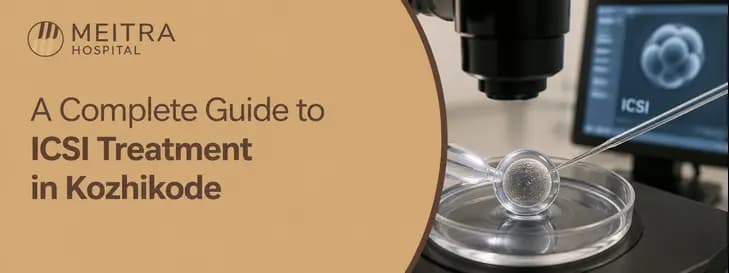
Intracytoplasmic Sperm Injection (ICSI) is a refinement performed within an IVF cycle. Instead of leaving fertilization to chance in a dish, an embryologist selects a single, healthy-looking sperm and injects it directly into the egg's cytoplasm using a fine glass needle under high-magnification microscopy. Every other part of the cycle, ovarian stimulation, egg retrieval, embryo culture, transfer, is identical to standard IVF. ICSI changes exactly one step: how the sperm meets the egg.
That distinction matters because it means ICSI is never "instead of" IVF. It's a fertilization technique used inside an IVF cycle when there's a specific reason to believe natural fertilization in the dish would fail or underperform.
Who Actually Needs ICSI? (Most Couples Don't)
ICSI was developed for one problem in particular: sperm that can't reliably fertilize an egg on their own. That still accounts for most legitimate indications today.
1. Male-factor infertility is the single largest driver.
ICSI is specifically indicated for:
- Very low sperm count (oligozoospermia) or poor motility (asthenozoospermia)
- Abnormal sperm morphology (teratozoospermia)
- Azoospermia, where sperm must be surgically retrieved via TESA/TESE/PESA
- Previous IVF cycles with low or failed fertilization
- Use of frozen sperm or donor sperm with limited sample volume.
2. Female-factor or combined-factor cases sometimes use ICSI too.
For instance, when very few eggs are retrieved and the clinic wants to maximize the fertilization chance of each one, or in cases of previous fertilization failure with standard IVF regardless of sperm parameters.
What ICSI does not fix: ovulatory disorders, tubal blockages, uterine abnormalities, or age-related egg quality decline. Couples with normal semen analysis and no history of failed fertilization gain no proven benefit from ICSI over conventional IVF, a distinction worth asking about directly, since ICSI adds cost without adding value in that scenario.
The ICSI Process, Step by Step
A typical ICSI cycle runs four to six weeks from the start of ovarian stimulation to the pregnancy test.
| Phase | What Happens | Typical Duration |
|---|---|---|
| Ovarian stimulation | Hormonal injections stimulate the ovaries to mature multiple eggs, monitored via ultrasound and bloodwork | 8–12 days |
| Trigger shot & egg retrieval | A trigger injection matures the eggs; retrieval is a short, sedated transvaginal procedure | Day 0 |
| Sperm collection/retrieval | Ejaculated sample, or surgical retrieval (TESA/PESA/TESE) for azoospermia cases | Same day as retrieval |
| ICSI (fertilization) | A single sperm is injected into each mature egg under a micromanipulation microscope | Same day, few hours later |
| Embryo culture | Fertilized eggs are monitored for cell division over 3–5 days | Day 1–5 |
| Embryo transfer | One (occasionally two) embryos are transferred into the uterus; remaining viable embryos may be frozen | Day 3 or Day 5 |
| Pregnancy test | Blood beta-hCG test | ~12–14 days after transfer |
The part patients rarely get walked through is what happens in the embryology lab on retrieval day. Once eggs are collected, the embryologist first strips away the surrounding cumulus cells to assess maturity, only mature (Metaphase II) eggs can be injected. Under an inverted microscope fitted with micromanipulator arms, the egg is held steady with a blunt holding pipette while a hollow injection needle, sharper than a human hair, immobilizes and picks up a single sperm before piercing the egg membrane and depositing the sperm directly into the cytoplasm. It takes seconds per egg, but the precision, and the embryologist's experience reading which sperm and which eggs are viable, is arguably the single biggest quality variable in the entire cycle, more than any equipment brand a clinic advertises.


ICSI Success Rates: What the Numbers Really Mean
Clinic websites often quote a single "success rate" without specifying which one. There are at least three distinct numbers, and they get conflated constantly:
Fertilization rate: The percentage of injected eggs that fertilize successfully. This is the number ICSI actually improves over conventional insemination, typically in the 77–82% range in experienced labs.
Clinical pregnancy rate: The percentage of embryo transfers resulting in a detectable pregnancy (heartbeat on ultrasound).
Live birth rate per cycle: The number that matters most to patients, and the one most influenced by factors ICSI itself doesn't control: the woman's age, egg quality, uterine receptivity, and embryo genetic normalcy.
This is worth spelling out plainly: ICSI improves fertilization, not egg quality or implantation. A couple with severe male-factor infertility and a 32-year-old partner will generally see much better overall outcomes than a couple using ICSI for the same sperm issue where the female partner is 40, because age affects the two numbers ICSI has no influence over. Any clinic quoting one blended "success rate" without separating these factors is oversimplifying a nuanced picture.
Also Read: When Do You Need Laparoscopic Surgery for Endometriosis?
PGT with ICSI: When Genetic Testing Is Worth Adding
Preimplantation Genetic Testing (PGT) is frequently paired with ICSI, and for good reason, since ICSI already involves handling individual embryos closely, biopsying a few cells for genetic screening before transfer is a natural add-on. PGT-A screens for chromosomal abnormalities (relevant with advancing maternal age or repeated miscarriage); PGT-M screens for a specific known inherited genetic condition in the family.
PGT is not automatically necessary for every ICSI cycle. It adds meaningful value for couples with a history of recurrent pregnancy loss, advanced maternal age (generally 35+), a known genetic condition in the family, or multiple previous failed IVF/ICSI cycles. For a first cycle in a younger couple with a straightforward male-factor indication, many reproductive specialists will recommend proceeding without PGT first and revisiting it only if needed, a conversation worth having explicitly rather than accepting it as a default add-on.
ICSI Treatment Cost in Kozhikode: What Drives the Price
Costs across Kozhikode's fertility centres vary based on the components bundled into the base cycle. Broadly, the price is shaped by:
| Cost Component | What Influences It |
|---|---|
| Base ICSI/IVF cycle | Medication protocol, number of monitoring visits, lab fees |
| Surgical sperm retrieval (TESA/PESA/TESE) | Only needed for azoospermia; adds a separate procedure cost |
| PGT-A / PGT-M | Number of embryos tested; per-embryo genetic testing fee |
| Embryo freezing & storage | Annual storage fees for surplus embryos |
| Donor gametes (if applicable) | Donor sperm or egg program fees, where medically indicated |
Rather than comparing a single headline number across clinics, ask specifically what's included in the quoted cycle price, medication, ultrasound monitoring, anaesthesia for retrieval, lab fees, and freezing, since these are frequently itemized separately and the "starting from" price rarely reflects what most patients actually pay.
Why Couples in Kozhikode Are Turning to Meitra Hospital's Fertility Pathway
For many couples, fertility treatment isn't simply about starting IVF or ICSI. The more important first step is identifying why pregnancy hasn't occurred. Meitra Hospital's Centre for Obstetrics and Gynaecology follows this evidence-based approach by prioritising comprehensive fertility evaluation before recommending assisted reproductive treatment. The department offers reproductive medicine services, preconception counselling, infertility investigations, and early interventions, ensuring that treatment decisions are guided by diagnosis rather than assumptions.
A thorough evaluation is particularly important because many infertility cases are linked to underlying conditions that may be medically or surgically treatable. Addressing these issues can sometimes restore natural fertility or improve the chances of success with assisted reproductive techniques.
Comprehensive Fertility Evaluation Under One Team
Meitra Hospital's fertility pathway includes:
-
Detailed fertility assessment for both partners
-
Preconception counselling and reproductive medicine consultation
-
Evaluation of conditions such as:
- PCOS-related ovulation disorders
- Endometriosis
- Uterine fibroids
- Tubal blockage
- Male-factor infertility
- Individualised treatment planning based on the identified cause of infertility.
Advanced Gynaecological Care That Supports Fertility
When surgery is clinically indicated, patients can access advanced minimally invasive procedures within the same department, including:
- Laparoscopic surgery
- Hysteroscopic surgery
- Surgical management of fibroids and endometriosis
- Procedures to improve the uterine environment before fertility treatment when appropriate
Having fertility evaluation and corrective procedures coordinated by the same multidisciplinary team helps streamline care and avoids unnecessary referrals between different centres.
Support Beyond Fertility Treatment
A successful fertility journey continues well beyond conception. Pregnancies following assisted reproductive treatments often require closer monitoring, making access to comprehensive obstetric care an important consideration.
Meitra Hospital's Obstetrics & Gynaecology department is supported by:
- 24×7 consultant obstetric and gynaecology services
- Level IV Neonatal Intensive Care Unit (NICU)
- Experienced neonatologists
- Maternal critical care services
- Multidisciplinary support for high-risk pregnancies
This integrated setup enables continuity of care from fertility evaluation through pregnancy, delivery, and newborn care when required.
Meitra Hospital: Accredited Multispeciality Care for Local and International Patients
Meitra Hospital is accredited by JCI, NABH, and NABL, reflecting internationally recognised quality standards across patient safety, laboratory services, infection control, and clinical care. The hospital has treated more than 600,000 patients, including patients travelling from Gulf countries and other international locations for specialised medical treatment.
For couples considering fertility treatment, a multispeciality hospital offers several practical advantages:
- Access to fertility specialists alongside endocrinologists, surgeons, genetic experts, and other specialists under one roof
- Coordinated management if infertility is associated with other medical conditions
- Seamless transition to high-risk pregnancy care when needed
- Dedicated international patient services for NRI and overseas patients
- Reduced coordination between multiple healthcare providers
Ultimately, every fertility journey is unique and requires an individualised treatment plan. However, choosing a centre that combines comprehensive diagnostics, advanced gynaecological expertise, multidisciplinary support, and full-spectrum obstetric care can provide couples with a more coordinated and informed pathway from fertility assessment through pregnancy and childbirth.
Our care team is available to walk you through a diagnostic evaluation and discuss whether ICSI, IVF, or a simpler intervention is right for you. Chat with our assistant to book a consultation.
Medical Disclaimer: This article is for general informational purposes only and does not constitute medical advice, diagnosis, or treatment recommendations. Fertility evaluation and treatment decisions should always be made in consultation with a qualified reproductive medicine specialist based on your individual medical history and diagnostic results. Statistics cited are drawn from published research and may not reflect outcomes for any specific individual or clinic.